




Analysis: Mixed assets a refuge to Shariah investors in choppy times
- Amid a rocky 2025, Islamic mixed assets provide diversification
- Tech, healthcare equities outperform, rise in gold-led commodities
- Cautious optimism seems to be way forward for mixed asset managers
Overview
As global markets began a tumultuous 2025, a particular class of investments designed to adapt to volatility – Shariah compliant mixed assets – demonstrated notable resilience, offering a haven for investors seeking both portfolio diversification and alignment with Islamic values.
Combining equities, fixed income and real estate, mixed assets have ridden out this year’s market gyrations. By mid-May 2025, the S&P Global BMI Shariah Index had seen a modest year-to-date decline of -0.98%, a slight lag behind the S&P 500's 0.3% gain.
Yet, when market pressures were at their peak, the Shariah index's lowest was around 16%, a less severe contraction than the S&P 500's 18% descent, which bordered on bear market territory – influenced by anxieties over escalating US trade tariffs, the Trump administration’s rhetoric and other global flare-ups.
Within the realm of Islamic equities, certain sectors proved more robust. Technology and healthcare generally outperformed while commodities were the most dynamic subsector within fixed income.
Against the pronounced price swings in energy and materials, flight to safety was particularly notable in precious metals and agricultural products, giving them a crucial role in buffering against downturns elsewhere in Islamic investment portfolios.
Gold futures, for example, soared more than 25% thus far into 2025, reaching an unprecedented high of just over US$3,500 an ounce.
The inclusion of Sukuk and Shariah compliant Islamic real estate, including REITs, further rounded out portfolio strategies for Muslim investors navigating the choppy waters of the first quarter.
Investment opportunity
The foundational principles of Islamic finance, which emphasize ethical and socially responsible investing, find a natural resonance with the burgeoning ESG criteria now guiding mainstream financial decisions.
Historically, the very structure of Islamic finance, characterized by its asset-backed transactions and emphasis on risk-sharing, has demonstrated remarkable resilience during periods of financial turmoil.
This inherent stability can be a compelling magnet for investors who prioritize prudence and seek to diversify their portfolios while safeguarding against economic downturns.
Indeed, Islamic funds have often proven their mettle, at times matching or even surpassing the performance of conventional benchmarks. For instance, the S&P 500 Shariah Index recorded an annualized total return of 10.2% over the 15 years ended on the 31st July 2019, comfortably outperforming the conventional S&P 500's 9.1%.
On the Sukuk front, new global volumes fell by nearly 15% in the first half of 2025, totaling US$101.3 billion, down from US$119 billion at mid-year 2024. Even so, total global Sukuk market is projected to reach US$1.29 trillion this year versus US$1.08 trillion in 2024.
Regulatory network
The Islamic finance industry contends with a lack of standardization and fragmented interpretations of Shariah principles across different jurisdictions that make it hard to apply rules to any particular asset class within the Shariah universe.
While organizations such as the AAOIFI and the IFSB are actively working towards unifying these standards, the pace of progress remains slow.
Liquidity management also presents a significant hurdle for Islamic banks, primarily due to a scarcity of readily available Shariah compliant high-quality liquid assets, making it difficult to fully satisfy Basel III requirements.
Potential remedies being explored include the issuance of Sukuk bonds against long-term portfolios and the development of common Musharakah pools to enhance liquidity.
Asset spread
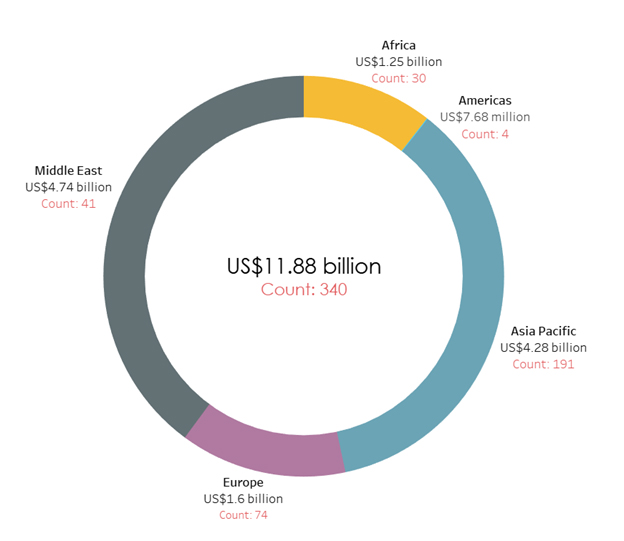
Despite their unquestionable value to portfolios, mixed assets have a long way to go in terms of scaling the Islamic financial universe. Some US$11.88 billion in mixed assets AuM is controlled by 340 funds, according to the IFN Investor Funds Database.
This pales in comparison with the global Islamic finance industry valued at US$3.9 trillion in 2024 and on trajectory to reach US$5.95 trillion by 2026 and potentially US$12.5 trillion by 2033, according to market forecaster Pruduor.
Breaking down the spread in mixed assets by region, the IFN Investor Funds Database notes the Middle East as having the largest share of the pie at 40%, with US$4.74 billion managed by 41 funds.
This is followed by the Asia Pacific’s US$4.28 billion mixed assets AuM run by 191 funds and Europe’s US$1.6 billion administered by 74 funds, Africa’s US$1.25 billion handled by 30 funds and Americas’ US$7.68 million overseen by four funds.
In terms of quarter-on-quarter (q-o-q) AuM growth, Europe experienced the biggest expansion, growing 14.37% in the latest quarter to June, despite being only the third largest regional hub for Islamic mixed assets.
The Americas were another exception, with a 10.6% growth that put them at the second spot, versus their standing as the smallest regional base for Shariah mixed assets.
The Middle East, the largest hub for Islamic mixed assets, grew just 4.81% q-o-q. Africa advanced by 1.98% while Asia Pacific saw the only negative growth, with an AuM decline of 0.43%.
Chart: Global Islamic mixed asset funds by region
Fund performance
The Al Rajhi Growth Fund, managed by Saudi Arabia’s Al Rajhi Capital, was the single largest mixed asset fund at the end of Q2 2025, with AuM of US$2.15 billion.
The growth-type fund aims to achieve a balance between capital preservation and capital development by distributing assets in funds in various securities categories that comply with the fund's Shariah controls.
Takafulink Dana Ekuiti, administered by Malaysian insurance manager Prudential BSN Takaful, had the second largest Islamic mixed asset fund, with US$624.29 million in AuM.
Public Islamic Asia Tactical Allocation Fund, another Malaysian fund belonging to Public Mutual, took the third spot with AuM of US$534.12 million.
Kenyan-owned Lapfund Amal Fund was fourth largest with US$510.05 million while the Al Rajhi Monthly Distribution Fund was fifth with US$496.44 million.
Table 1: Largest Islamic mixed asset funds at end of Q2 2025
| Fund | Manager | Type | AuM (US$ million) |
| Al Rajhi Growth Fund | Al Rajhi Capital | Growth | 2,151.65 |
| Takafulink Dana Ekuiti | Prudential BSN Takaful | Income | 624.29 |
| Public Islamic Asia Tactical Allocation Fund | Public Mutual | Growth | 534.12 |
| Lapfund Amal Fund | Lapfund | Retirement | 510.05 |
| Al Rajhi Monthly Distribution Fund | Al Rajhi Capital | Income | 496.44 |
Table 2: Best performing Islamic funds at the 30th June 2025
| Fund | Manager | Type | Three-month returns (%) |
| Allbatross Portfolio Short-Term Participation Free (TL) Fund | Allbatross Portfoy | Others | 11.61 |
| AXA Life And Retirement Initial Participation Retirement Investment Fund | AXA Hayat ve Emeklilik | Retirement | 11.45 |
| AXA Life And Retirement Oks Aggressive Participation Variable Retirement Investment Fund | AXA Hayat ve Emeklilik | Retirement | 11.07 |
| Al-Ameen Islamic Aggressive Income Plan-I | UBL Funds | Income | 10.99 |
| Garanti Portfolio Participation Free (TL) Fund | Garanti Portfoy | Income | 10.75 |
Turkiye’s Allbatross Portfoy was the best performing Islamic mixed assets manager, with a return of 11.61% on its Allbatross Portfolio Short-Term Participation Free (TL) Fund for the three months ended the 30th June 2025. The fund is described as a short-term maturity vehicle that undergoes rebalancing every 25 to 90 days.
The AXA Life And Retirement Initial Participation Retirement Investment Fund, another Turkish fund run by AXA Hayat ve Emeklilik, was second best during the period, posting a return of 11.45%.
The AXA Life And Retirement Oks Aggressive Participation Variable Retirement Investment Fund came in third, with a return of 11.07%.
The Al-Ameen Islamic Aggressive Income Plan-I, belonging to Pakistan’s UBL Funds, posted a return of 10.99% for fourth placing while Turkiye’s Garanti Portfoy emerged fifth with a return of 10.75%.
Outlook
The prognosis for Shariah compliant mixed assets through the remainder of 2025 is characterized by cautious optimism.
The inherent diversification benefits embedded within these portfolios are anticipated to remain a key draw for investors seeking to navigate persistent market uncertainty.
Furthermore, the expanding global footprint of Islamic finance and heightened awareness of ethical investing principles collectively provide a supportive long-term framework.
Nevertheless, market participants will need to closely monitor evolving global macroeconomic trends, shifts in interest rate policy and geopolitical developments – each of which has the potential to impact the performance of the underlying asset classes. The agility of fund managers in dynamically adjusting asset allocations, while strictly adhering to Shariah compliant guidelines, will be paramount in generating consistent returns.
Restricted Access
Login to continue reading (existing subscriber)
Subscribe NOW and get:
- Gain unlimited access through all key operating platforms
- Full access to all listed Islamic funds & fund profiles
- Unlimited access to all Islamic fund managers
- Access to all exclusive articles, reports, podcasts & videos
- Complimentary access to all IFN Investor Forums
