




- A market of potential that can leverage on the strength of its 90% Muslim population
- Equity funds dominate by almost 54% of total AuM
- For diversification, Bangladesh needs to grow offerings with Sukuk, money market and commodities
Overview
For Bangladesh, its Shariah funds, while demonstrating strong local demand, operate within a tightly restricted universe of assets and an emerging regulatory framework.
The country’s greatest strength is a demographic imperative. With over 90% of its population being Muslim, the appetite for Shariah compliant financial products is enormous and structurally significant.
Even so, a major vulnerability for the Bangladeshi model is the severe scarcity of Shariah compliant instruments. As the IFN Investor Funds Database data on domestic funds illustrate, managers are funneled into a narrow band of equities.
Unlike Malaysia and the GCC region, which collectively dominate the global Islamic funds market, Bangladesh has an extremely limited domestic offering of Shariah-indexed equities and a handful of Sukuk issuances.
While Malaysia is a powerhouse in Sukuk, offering managers a deep, highly liquid fixed-income alternative, and the GCC offers vast pools of capital and sophisticated products for wealth management, Bangladesh’s absence of diverse, liquid, compliant asset classes creates a severe constraint on diversification, portfolio risk management and overall fund size. In essence, fund managers have fewer places to responsibly put that money.
Investment opportunity
Bangladesh's Shariah compliant fund market demonstrates both its focus and its scale in the third quarter, with equitiescommanding the lion's share of AuM.
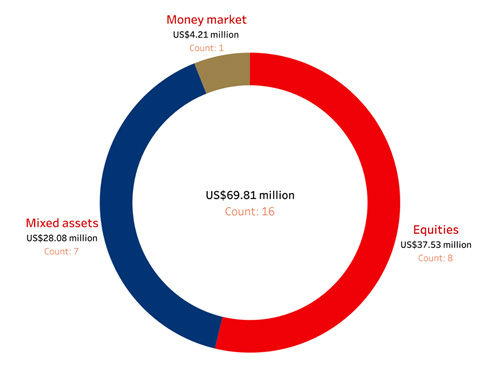
Data compiled by the IFN Investor Funds Database show an overall AuM of US$69.81 million across 16 public funds – underscoring the growing, yet still contained, niche of Islamic finance in the nation's broader financial landscape.
The quarter's figures reveal a clear preference for growth-oriented investments, in line with global Islamic finance trends that often favor equity and other capital market segments.
Equities maintain pole position
The sector’s dominance was unmistakable, accounting for over half of the market's total value. Equity funds reached US$37.53 million in assets.
The category was served by eight distinct funds, representing 53.8% of total AuM. This strong tilt toward stocks highlights investor faith in the long-term prospects of Shariah compliant companies in Bangladesh, aligning with the country's robust economic growth narrative.
Mixed assets provide diversification
Trailing equities was the mixed assets category which pulled in substantial capital from investors seeking a balanced strategy. This segment held US$28.08 million in AuM. It was also the second most popular category by fund count, comprising seven funds with a combined 40.2% share of total AuM.
Mixed-asset funds typically combine equities with fixed-income instruments like Sukuk and real assets and commodities, like gold, offering a degree of stability for those not fully committed to pure equity risk.
Money market's modest footprint
Typically, a home for short-term liquidity and low-risk investments, the money market segment played a decidedly smaller role in the latest quarter's total. Money market funds held a modest US$4.21 million, represented by one solitary fund.
Bangladesh’s Shariah model shows that the bulk of its ethical capital was allocated for strategic investment rather than held in ultra-liquid accounts. This indicates an active, risk-on approach by fund managers and investors.
Chart 1: Bangladeshi Shariah market by asset class and fund count
Fund assets
Bangladesh’s Shariah fund industry is dominated by a clear leader: HF Asset Management, which manages US$16.69 million in assets, representing roughly 35% of the AuM held by the top five funds.
This dominance signals a market where institutional faith – or perhaps early mover advantage – is heavily weighted toward a single fund house.
Other significant players include ICB Asset Management (US$9.67 million) and Strategic Equity Management (US$7.82 million).
As the market in Dhaka continues its trajectory, its long-term success will rely on fund managers' abilities to extract superior returns from a relatively narrow band of compliant assets while maintaining the ethical rigor that defines their value proposition.
Table 1: Top Bangladeshi Shariah funds by AuM
| Rank | Fund | AuM (US$ million) |
| 1 | HF Asset Management | 16.69 |
| 2 | ICB Asset Management | 9.67 |
| 3 | Strategic Equity Management | 7.82 |
| 4 | LR Global Bangladesh | 7.41 |
| 5 | IDLC Asset Management | 6.36 |
Outlook
The "value" proposition in Bangladesh’s Shariah sector – adherence to Islamic financial principles – is also the source of its market with a profound asset bias towards equity. With conventional fixed-income assets excluded, managers are channeled into common stocks and Shariah compliant instruments like Sukuk that represent fractional ownership in real assets.
This structural limitation can potentially lead to an intrinsic challenge in creating a well-diversified portfolio and may explain why some studies suggest Shariah funds may carry a lower level of diversification compared to their conventional counterparts.
In essence, while the devout clientele in Bangladesh provides a strong stream of capital for Islamic funds, the lack of depth in the domestic capital markets means fund managers have fewer places to responsibly put that money.
The challenge for Dhaka is not attracting the faithful but constructing the world-class institutional infrastructure that the great Islamic finance hubs have spent decades perfecting.
Restricted Access
Login to continue reading (existing subscriber)
Subscribe NOW and get:
- Gain unlimited access through all key operating platforms
- Full access to all listed Islamic funds & fund profiles
- Unlimited access to all Islamic fund managers
- Access to all exclusive articles, reports, podcasts & videos
- Complimentary access to all IFN Investor Forums
