




- Asia Pacific leads with AuM of US$11.87 billion
- Turkey’s Ziraat Portfoy manages largest fixed income fund of US$1.52 billion
- ESG mandates drive a projected US$310 billion climate adaptation
Bolstered by Malaysia, the founding hub of Southeast Asia’s Islamic market, to Saudi Arabia, the powerhouse of the GCC, Shariah fixed income AuM reached US$26.52 billion last year.
The milestone, tracked by the IFN Investor Funds Database, confirms that faith-based ethical investing has moved from the financial periphery into the global mainstream of fixed income with 409 active and highly diverse investment funds.
The valuation is the highest the database has ever noted in Shariah fixed income funds space, after the AuM of just over US$20 billion in 2024.
Marketplace
Sukuk is the foundational pillar of Shariah fixed income, reaching a value of US$264.8 billion in 2025, according to S&P Global, which projects continuous growth of this Islamic instrument in 2026 to US$270-280 billion.
Beyond Sukuk, the Shariah fixed income marketplace relies on Murabahah-based liquidity instruments and Wakalah agency agreements to manage institutional capital flows effectively and transparently.
While Ijarah provides a tangible asset-backed foundation for long-term fixed income portfolios, particularly within the Middle Eastern market, commodity Murabahah, often referred to as Tawarruq, serves as a vital tool for interbank liquidity and managing the cash positions of various Shariah fixed income funds worldwide.
Asset spread
Asia Pacific is the undisputed market leader, controlling US$11.87 billion through 236 funds, largely due to Malaysia’s US$8.27 billion contribution to the sector.
Table 1: Shariah fixed income fund performance by region
| Region | AuM Q2 2025 | AuM Q3 2025 | Change (%) |
| Africa | 174.79 | 184.83 | 5.74% |
| Americas | 602.52 | 702.43 | 16.58% |
| Asia Pacific | 9,093.92 | 11,870.28 | 30.53% |
| Europe | 5,754.48 | 6,417.20 | 11.52% |
| Middle East | 7,010.78 | 7,349.82 | 4.84% |
The region pioneered this market in the 1990s through standardized regulatory frameworks, allowing institutional players to utilize Sukuk as their primary liquidity management tool.
Asia Pacific was the fastest-growing region for fixed income last year, growing 30.53% between Q2 2025 and Q3 2025 – with two key standouts of Malaysia and Pakistan.
The IFN Investor Funds Database showed one Malaysian fund – the AHAM Aiiman Income Fund - which recorded a 89.6% increase in NAV value to US$1.33 billion from US$700.1 million to skew the total country AuM figure. Fund manager AHAM Capital Asset Management noted in its review that corporate borrowers were taking advantage of the OPR cut in July 2025 to lock in gains from existing Sukuk.
For Pakistan, the growth in total funds AuM was prompted by the same rationale – securing Sukuk returns as the central bank had progressively reduced interest rates over 2025.
The Middle East remains a high-value powerhouse with US$7.35 billion, specifically driven by Saudi Arabia’s US$5.14 billion push into state-backed Islamic financing initiatives. These funds are surging now because GCC governments are aggressively diversifying their economies and require massive capital for their multi-billion dollar infrastructure transformations.
But the huge individual size of Middle East markets like Saudi Arabia and the UAE also masks their growth opportunity ratios when compared with their nimbler counterparts in Asia Pacific. Middle East fixed income funds total AuM expanded by 4.48% between Q2 2025 and Q3 2025.
Europe has emerged as a surprising dark horse, managing US$6.42 billion through 91 funds as Western investors pivot toward ethical mandates and geographic diversification. Turkiye acts as a critical bridge between regions, holding a substantial US$4.1 billion in assets across 63 active and highly diverse fixed income investment funds.
Meanwhile, the Americas and Africa remain in the early stages, cumulatively representing less than one billion US dollars in AuM of the total global Shariah pie. They are also regions with high growth promise, growing 16.58% and 5.74%, respectively, between Q2 2025 and Q3 2025.
Chart 1: Shariah fixed income funds by region
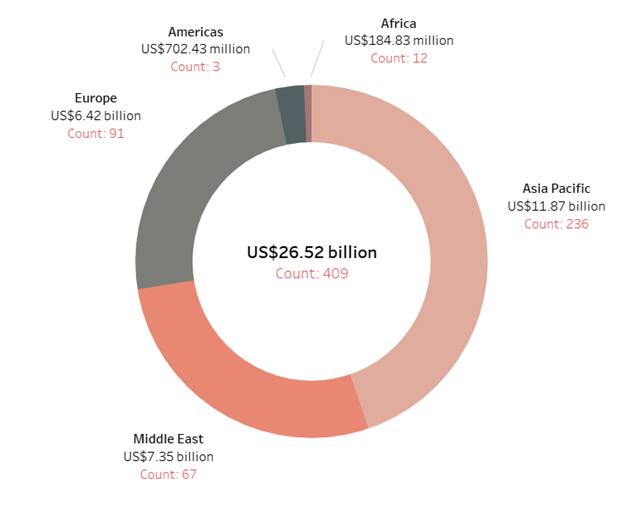
Chart 2: Shariah fixed income funds by country, fund count and AuM

Table 2: Largest Shariah fixed income funds
| Rank | Fund | Manager | AuM (US$ million) |
| 1 | Ziraat Portfolio Amber Money Market Participation Free (TL) Fund | Ziraat Portfoy | 1,519.25 |
| 2 | AHAM Aiiman Income Fund | AHAM Capital Asset Management | 1,348.93 |
| 3 | Riyad SAR Diversified Trade Fund | Riyad Capital | 1,286.63 |
| 4 | Franklin Global Sukuk Fund - A | Franklin Templeton | 922.19 |
| 5 | Albilad SAR Murabaha Fund | Albilad Capital | 632.58 |
| 6 | Turkiye Life And Retirement Oks Participation Standard Retirement Investment Fund | Turkiye Hayat Ve Emeklilik | 632.47 |
| 7 | Aiiman Income Extra Fund | AIIMAN Asset Management | 631.71 |
| 8 | AZ Multi Asset AZ Islamic - MAMG Global Sukuk A-ME (USD ACC) | Azimut Investment | 576.00 |
| 9 | Trimegah Dana Tetap Syariah Kelas A | Trimegah Asset Management | 547.42 |
| 10 | Azimut Global Sukuk Fund | ADIB Capital | 533.70 |
Table 3: Top performing Shariah fixed income funds
| Rank | Fund | Manager | Three-months return (%) |
| 1 | Albaraka Portfolio Management Second Rental Certificates Participation Venture Capital Investment Fund | Albaraka Portfoy | 18.22 |
| 2 | Agesa Life And Retirement Participation Contribution Retirement Investment Fund | AgeSA Hayat ve Emeklilik | 11.85 |
| 3 | Bereket Retirement And Life Initial Participation Retirement Investment Fund | Bereket Emeklilik ve Hayat | 11.64 |
| 4 | Agesa Life And Retirement Participation Standard Retirement Investment Fund | AgeSA Hayat ve Emeklilik | 11.63 |
| 5 | Mahaana IGI Islamic Retirement Fund - Debt | Mahaana | 11.34 |
| 6 | Agesa Life And Retirement Initial Participation Retirement Investment Fund | AgeSA Hayat ve Emeklilik | 11.27 |
| 7 | Garanti Retirement And Life Start Participation Retirement Investment Fund | Garanti Emeklilik Ve Hayat | 11.19 |
| 8 | Anadolu Life Retirement Initial Participation Retirement Investment Fund | Anadolu Hayat Emeklilik | 11.15 |
| 9 | Turkiye Life And Retirement Initial Participation Retirement Investment Fund | Turkiye Hayat Ve Emeklilik | 11.13 |
| 10 | Aktif Portfoy Lease Certificate Participation (TL) Fund | Aktif Portfoy | 11.03 |
Largest fund, top performer
The largest fund and the best performing one in Shariah fixed income are both from Turkey, reinforcing the country’s dominance of the European Islamic finance hub.
Ziraat Portfoy, manager of the US$1.52 billion Ziraat Portfolio Amber Money Market Participation Free Fund, runs over 100 distinct funds and currently ranks among the top five global Islamic commodity fund managers. Its group AuM is approximately around US$2.9 billion.
The Amber Money Market Participation Free Fund itself invests primarily in capital market instruments like lease certificates and ethical partnership interests. It commands a 37% share of the Turkish fixed income funds market, which totals US$4.1 billion across 63 funds.
The Albaraka Portfoy’s return of 18.22% on its Albaraka Portfolio Management Second Rental Certificates Participation Venture Capital Investment Fund comes from a strategy that leverages the structural benefits of the Murabahah and Wakala agreements.
As a specialized venture capital vehicle, the Second Rental Certificates fund also invests in diversified real estate and infrastructure projects through issuance of asset-backed securities for long-term capital appreciation.
Outlook
Asia-Pacific looks poised to remain as the primary engine of growth for Shariah fixed income funds, having already demonstrated a near 31% growth across a quarter of 2025.
Turkey, meanwhile, is expected to stay as the dominant European hub, with firms like Albaraka Portfoy leveraging a growing domestic market to deliver specialized venture capital vehicles.
Islamic fixed income is now moving toward a "Return on Resilience" model, where Shariah compliant instruments are converging with ESG mandates to fund an estimated US$310 billion annual climate adaptation gap, according to the United Nations Environment Program.
This ethical bridge, combined with the integration of AI-driven climate risk modeling, is transforming Islamic fixed income from a niche alternative into a core pillar of the global disaster economy.
Restricted Access
Login to continue reading (existing subscriber)
Subscribe NOW and get:
- Gain unlimited access through all key operating platforms
- Full access to all listed Islamic funds & fund profiles
- Unlimited access to all Islamic fund managers
- Access to all exclusive articles, reports, podcasts & videos
- Complimentary access to all IFN Investor Forums
