


- South Africa leads the continent’s Islamic investment landscape
- Challenges include a slowing economy and market in need of diversification
- By leveraging its strengths, South Africa can still be a template for the region
Overview
In South Africa, the pursuit of financial growth aligned with moral conviction has forged a Shariah market the IFN Investor Funds Database values at US$5.28 billion in total AuM – the African continent’s most robust ethical finance platform.
The story of this market is one of steady institutional adoption following decades of community-led efforts. It started with the establishment of South Africa’s first full-fledged Islamic bank, Albaraka, in 1989 – the same year that imprisoned president-in-making Nelson Mandela began negotiations with the then-government.
Post-apartheid, the financial community responded by integrating Islamic "windows," recognizing the demand for products that foster ethical, real-asset backed wealth creation.
Today, the South African Shariah landscape stands as a success story of inclusion, providing a vital option for investors previously excluded from conventional financial products.
In comparison, Kenya – Africa’s second largest Islamic market – is just a tenth in size, at under US$525 million worth of Islamic assets tracked by the IFN Investor Funds Database.
But the South African model is not without its challenges. Sukuk issuance has stalled the past two years after the ZAR20.4 billion (US$1.08 billion) issue in 2023 as Pretoria continues relying on the established, conventional debt market for its overall funding needs.
In July, South Africa’s National Treasury issued a call for "innovative foreign currency financing solutions" to raise at least US$500 million for the 2025/26 fiscal year, following parliament’s resolution of a protracted budget impasse that had threatened fiscal stability – a plan that had reportedly attracted over 100 global proposals.
Notwithstanding this, fund managers face slowing economic growth – Fitch forecasts a compounded GDP expansion of 1.2% for 2025-2027, versus 3.8% for 2022-2024 – and a marketplace that needs more diversification of its product suite to attract global Islamic capital.
Asset spread
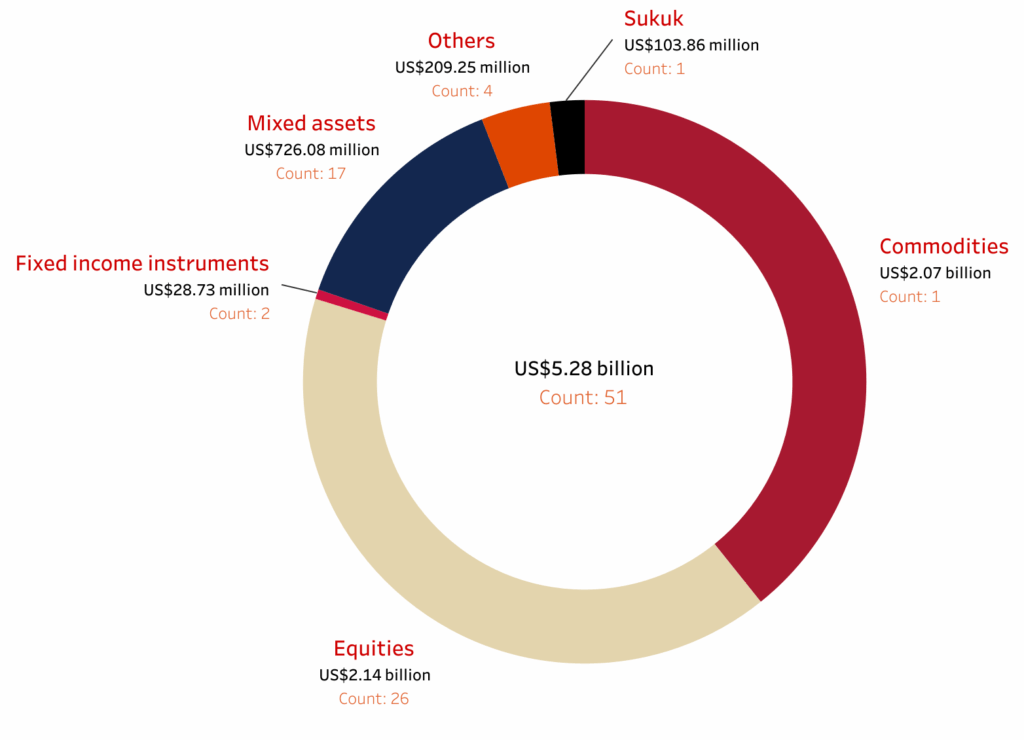
Investors seeking Shariah compliance in South Africa will find assets clustered across 51 funds, the IFN Investor Funds Database shows.
AuM is highly concentrated, with the commodities asset class represented by a single gold fund valued at US$2.07 billion.
Equities hold the next largest share at US$2.14 billion but represent the bulk of product offerings with 26 funds.
Mixed assets are third largest with an AuM of US$726.08 million and fewer fund count of 17.
Fixed income ranks fourth at US$28.73 million in just two funds. Meanwhile, there are four equity feeder funds with a combined asset base of US$209.25 million classified as ‘Others’.
The smallest asset class is Sukuk at US$103.86 million and reflected by just one fund.
Chart 1: South African Shariah funds by asset class, fund count and AuM00
In terms of geographical spread, South Africa’s Shariah market has no parallel on the continent with its 51 funds and AuM of US$5.28 billion.
Chart 2: African Shariah funds by geographical spread, fund count and AuM
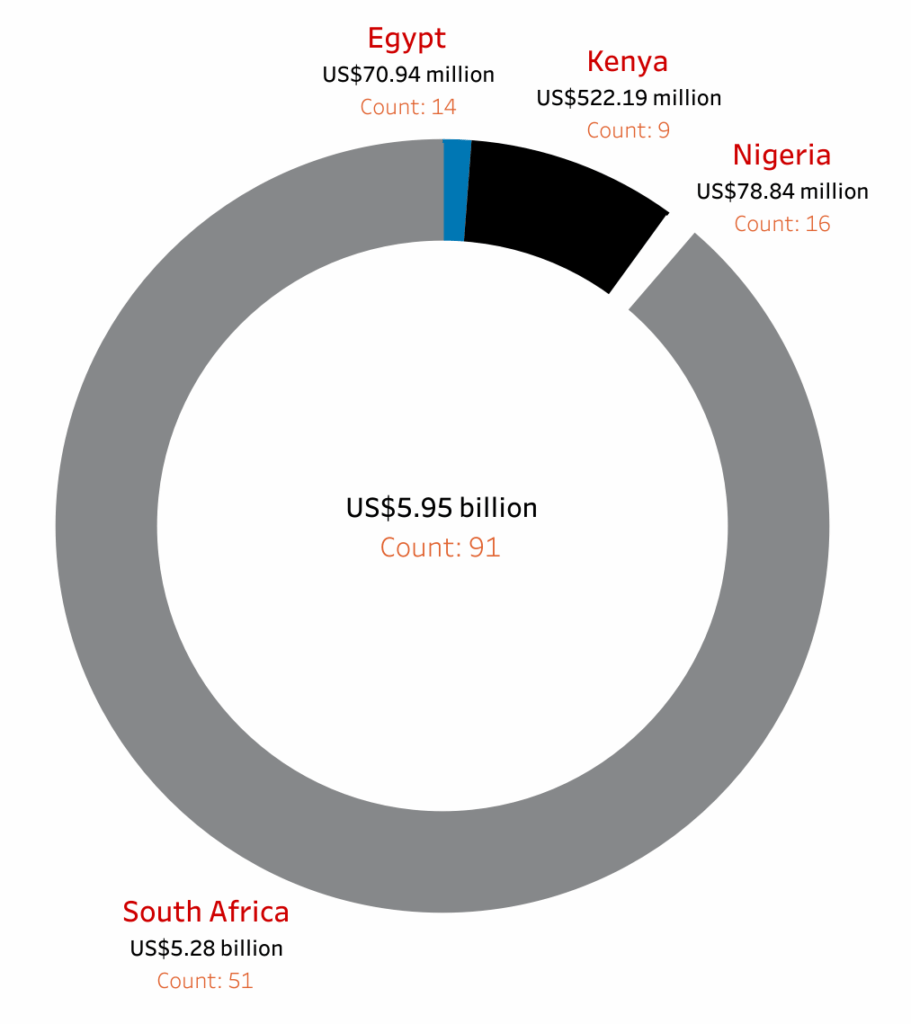
Kenya is the closest comparison, with an AuM of US$522.19 million and nine funds. Nigeria ranked fourth with US$78.84 million and 16 funds, while the smallest of the lot – Egypt – had an AuM of US$70.94 million and 14 funds.
Asset performance
The highest capitalized fund in South Africa’s Shariah market was the Absa Bank-managed NewGold ETF, valued at US$2.07 billion.
It tops five funds ranked by their AuM including Oasis Crescent’s equities-based Oasis Crescent Preservation Pension Fund (US$350 million); Old Mutual Unit Trust’s Old Mutual Albaraka Balanced Fund (US$317.35 million); Oasis Crescent’s Oasis Crescent Equity Fund (US$311.58 million) and Camissa Asset Management’s Islamic Balanced Fund ($264.27 million).
Table 1: South African Shariah funds ranked by AuM
| Rank | Fund | Manager | AuM (US$ million) |
| 1 | NewGold ETF | Absa Bank | 2,073.17 |
| 2 | Oasis Crescent Preservation Pension Fund (High Equity) | Oasis Crescent | 350 |
| 3 | Old Mutual Albaraka Balanced Fund | Old Mutual Unit Trust | 317.35 |
| 4 | Oasis Crescent Equity Fund | Oasis Crescent | 311.58 |
| 5 | Islamic Balanced Fund | Camissa Asset Management | 264.27 |
In terms of fund returns, 27 Four Investment Managers’ 27four Shariah Active Equity Fund led with a 6.25% return over three months.
27 Four Investment Managers also had the second-best performing fund – the 27four Shariah Wealth Builder Fund – with a three-month return of 4.98%.
Others with notable three-month returns were NewGold ETF (4.82%), 27four Shariah Multi-Managed Balanced Fund (4.67%) and 27four Shariah Balanced Fund of Funds (4.05%).
Table 2: South African Shariah funds ranked by returns
| Rank | Fund | Manager | Asset Class | 3-month return (%) |
| 1 | 27four Shariah Active Equity Fund | 27 Four Investment Managers | Equities | 6.25 |
| 2 | 27four Shariah Wealth Builder Fund | 27 Four Investment Managers | Equities | 4.98 |
| 3 | NewGold ETF | Absa Bank | Commodities | 4.82 |
| 4 | 27four Shariah Multi-Managed Balanced Fund | 27 Four Investment Managers | Mixed assets | 4.67 |
| 5 | 27four Shariah Balanced Fund of Funds | 27 Four Investment Managers | Equities | 4.05 |
Outlook
The market's next evolution faces the dual challenge of low domestic growth and the structural difficulties of operating a Shariah compliant system within a secular global economy.
Yet, South Africa’s focus on transparency and ethical business practices gives it a unique resonance with the global ESG movement.
By leveraging its established compliant frameworks – including Johannesburg Stock Exchange standards and legal recognition since 2010 – South Africa is positioned to export this model, allowing its ethical finance to become a template for sustainable growth across the continent.
Restricted Access
Login to continue reading (existing subscriber)
Subscribe NOW and get:
- Gain unlimited access through all key operating platforms
- Full access to all listed Islamic funds & fund profiles
- Unlimited access to all Islamic fund managers
- Access to all exclusive articles, reports, podcasts & videos
- Complimentary access to all IFN Investor Forums
