




From the ashes of 2008, Ireland turns into major European Shariah hub
- Ireland’s Islamic pivot in 2010, post-financial crisis, delivers Shariah hub
- Within the EU, Irish markets offer Islamic investors everything the UK cannot
- Language, common law, prolific Sukuk issuance poised to defend Ireland’s standing
Overview
From the mid-1990s to 2007, Ireland’s unprecedented boom earned it the moniker of a ‘Celtic Tiger’ – the European equivalent of an ‘Asian Tiger’ economy. But the 2008 global financial crisis left the Irish property market and banking system in shambles. Then, another revolution rooted in Islamic finance began by 2010 – transforming the second-largest island in the British Isles into the European Shariah hub it is today.
The two-phased reinvention of the Irish economy has become a model for any nation seeking to leverage existing infrastructure and expertise to become a key player in the global Islamic financial landscape.
With a strategic policy shift in 2010, Ireland indeed emerged as a key player in the European Shariah sector after the Irish Central Bank authorized several Islamic institutions to operate from the International Financial Services Centre in Dublin. The shift came on the back of a lower 12.5% corporate tax rate and direct access to the EU market sanctioned by the central bank.
Today’s figures tell the story. The nearly 80 Islamic funds in Ireland tracked by the IFN Investor Funds Database at the close of Q2 2025 account for an asset base of more than US$10 billion. That makes Ireland’s Shariah market Europe’s second largest after Turkiye – the transcontinental country with territory in both Europe and Asia – which had 256 funds valued at $28.75 billion as of mid-2025.
Investment opportunity
Ireland's well-established infrastructure and expertise in Islamic finance make it an attractive entry point for institutions aiming to access the large EU investment market from a single location.
The country’s financial success is evident in its domination of the European ETF market, attracting 60% of this market segment’s activity to its shores.
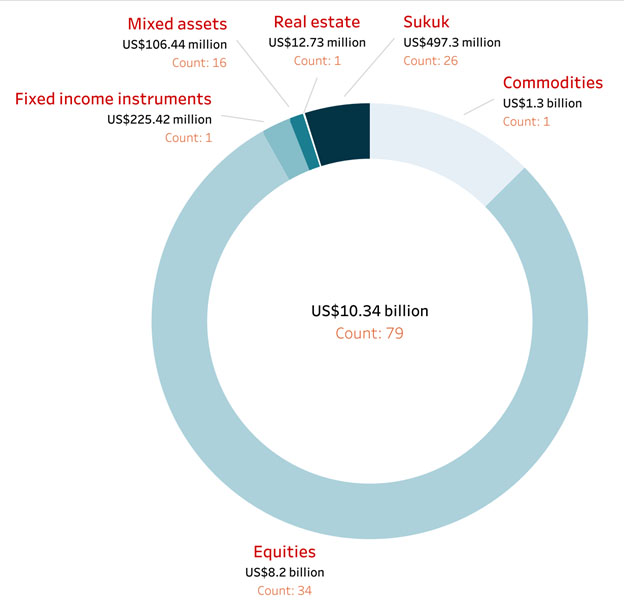
On the Shariah front, Irish laws treat Islamic-based financial products the same as conventional ones. More than 80% of the Irish investment market tracked by the IFN Investor Funds Database is dominated by Shariah compliant equities. Commodities, fixed income instruments and Sukuk have significant presence as well with market shares of 13%, 2% and 5%, respectively.
Separately, the Irish Stock Exchange – Euronext Dublin – remains a popular venue for Sukuk listings. Exchange data shows the Euronext involved in US$4.25 billion worth of Sukuk issuance for all of 2024.
Asset spread
Total value of assets in the Irish Shariah market stands at US$10.34 billion, spread across 79 funds, the IFN Investor Funds Database shows.
Equities make up the largest portion of the market, with US$8.2 billion shared by 34 funds.
Sukuk constitutes a value of US$497.3 million, with 26 funds on the ground.
Mixed assets are at US$106.44 million, with a fund count of 16.
Commodities, fixed income instruments and real estate are all represented by one fund each, with varying values of US$1.3 billion, US$225.42 million and US$12.73 million, respectively.
Chart 1: Ireland’s Islamic asset class breakdown
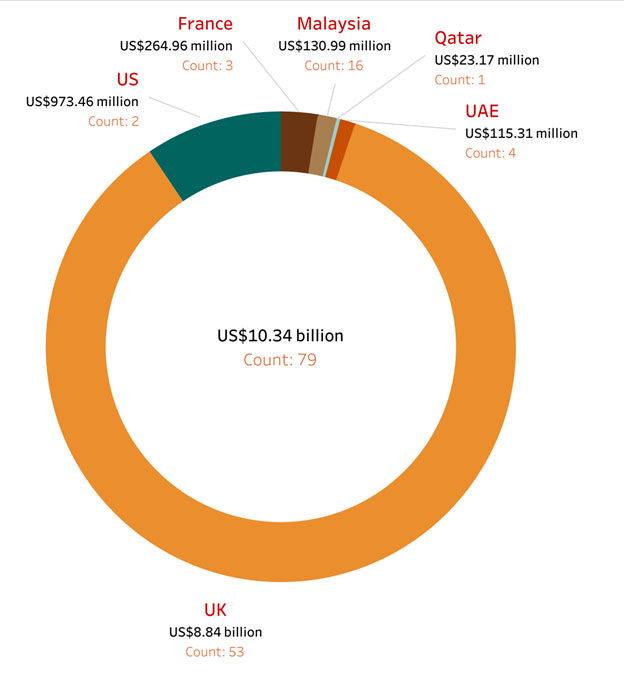
Of the 79 funds, a total of 53 are UK firms domiciled in Ireland, with a combined AuM of US$8.84 billion. US firms represent the second largest value of US$973.46 million, spread over just two funds. Next in line are French fund managers, with a combined market share of US$264.96 in three funds.
Malaysian firms account for 16 funds, with a total value of US$130.99 million; the UAE contributes US$115.31 million across four funds; while Qatar has a solitary fund worth US$23.17 million.
Chart 2: Ireland’s Islamic assets by country
Fund performance
The largest Islamic fund in Ireland by a significant margin is the HSBC UCITS Common Contractual Fund - Islamic Global Equity Index Fund. With over US$4.1 billion in AuM, it is managed by HSBC Asset Management. The second largest is The Royal Mint Responsibly Sourced Physical Gold ETC, with AuM of nearly US$1.3 billion.
Other major players include Invesco Capital Management, which runs the Invesco Dow Jones Islamic Global Developed Markets UCITS ETF (US$953 million), and iShares (BlackRock), which manages three of the top 10 funds. The three iShares funds – iShares MSCI World Islamic UCITS ETF, iShares EM Islamic UCITS ETF and iShares MSCI USA Islamic UCITS ETF – collectively have over US$1.3 billion in assets.
State Street Global Advisors' SPDR JPMorgan Saudi Arabia Aggregate Bond UCITS ETF is also a significant fund with AuM of US$225 million.
Table 1: Ireland’s Islamic funds, ranked by AuM
| Rank | Fund | Manager | AuM (US$ million) |
| 1 | HSBC UCITS Common Contractual Fund - Islamic Global Equity Index Fund - Class A2CGBP | HSBC Asset Management | 4,147.49 |
| 2 | The Royal Mint Responsibly Sourced Physical Gold ETC | HANetf Management | 1,296.96 |
| 3 | Invesco Dow Jones Islamic Global Developed Markets UCITS ETF Acc | Invesco Capital Management | 953.66 |
| 4 | HSBC UCITS Common Contractual Fund - Islamic Global Equity Index Fund - Class D3CGBP | HSBC Asset Management | 791.39 |
| 5 | iShares MSCI World Islamic UCITS ETF | iShares (BlackRock) | 785.16 |
| 6 | iShares MSCI EM Islamic UCITS ETF | iShares (BlackRock) | 319.01 |
| 7 | HSBC Global Funds ICAV - Global Sukuk UCITS ETF - Class S1CGBP | HSBC Asset Management | 287.14 |
| 8 | iShares MSCI USA Islamic UCITS ETF | iShares (BlackRock) | 253.84 |
| 9 | SPDR JPMorgan Saudi Arabia Aggregate Bond UCITS ETF (Acc) | State Street Global Advisors | 225.42 |
| 10 | Aviva Pension HSBC Islamic Global Equity Index FP | Aviva | 123.89 |
As for the largest fund managers, HSBC Asset Management holds the top position, with AuM of over US$5.5 billion. iShares (BlackRock) follows, with assets of over US$1.4 billion. HANetf Management is ranked third, with AuM of more than US$1.3 billion.
Other notable fund managers include Invesco Capital Management (US$953.66 million), Comgest (US$265.04 million), Aviva (US$260.47) State Street Global Advisors (US$225.42 million), Principal Asset Management (US$110.69 million), First Abu Dhabi Bank (US$85.09 million) and AD Global Investor (US$30.2 million).
Table 2: Ireland’s Islamic fund managers, ranked by AuM
| Rank | Manager | AuM (US$ million) |
| 1 | HSBC Asset Management | 5,590.72 |
| 2 | iShares (BlackRock) | 1,420.05 |
| 3 | HANetf Management | 1,312.44 |
| 4 | Invesco Capital Management | 953.66 |
| 5 | Comgest | 265.04 |
| 6 | Aviva | 260.47 |
| 7 | State Street Global Advisors | 225.42 |
| 8 | Principal Asset Management | 110.69 |
| 9 | First Abu Dhabi Bank | 85.09 |
| 10 | AD Global Investor | 30.2 |
On the returns end, Baillie Gifford & Co top the list, with four funds that gained between 20.1% and 21.07% during the three months ended June 2025.
In the prospectus of its flagship Worldwide Islamic Global Equities Fund, Ballie Gifford outlines its investment strategy, saying it uses a ‘bottom-up’ approach to identify companies that can achieve superior earnings growth over sustained periods. The firm adds that a long-term perspective and Islamic principles are complementary, leading to the identification of exceptional growth opportunities.
J O Hambro Capital Management Group’s 19.2% return for the JOHCM Global Select Shariah Fund is next in line after the four Ballie Gifford funds. Other top performers include a fund from Sands Capital at 18% and two funds from HSBC Asset Management with returns of 18.52% and 16.13%.
The list is rounded out by two funds from HANetf Management, which recorded returns of 15.6% and 15.17%.
Table 3: Ireland’s Islamic funds, ranked by three-month returns
| Rank | Fund | Manager | Three-months return (%) |
| 1 | Baillie Gifford Worldwide Islamic Global Equities Fund B USD Acc | Baillie Gifford & Co | 21.07 |
| 2 | Baillie Gifford Worldwide Islamic Global Equities Fund B EUR Acc | Baillie Gifford & Co | 20.39 |
| 3 | Baillie Gifford Worldwide Islamic Global Equities Fund B CHF Acc | Baillie Gifford & Co | 20.16 |
| 4 | Baillie Gifford Worldwide Islamic Global Equities Fund B GBP Acc | Baillie Gifford & Co | 20.1 |
| 5 | JOHCM Global Select Shariah Fund | J O Hambro Capital Management Group | 19.2 |
| 6 | HSBC Amanah Global Equity Index USD | HSBC Asset Management | 18.52 |
| 7 | Sands Capital Global Shariah A US Dollar Accumulating Class | Sands Capital | 18 |
| 8 | HSBC MSCI USA Islamic ESG UCITS ETF | HSBC Asset Management | 16.13 |
| 9 | The Royal Mint Responsibly Sourced Physical Gold ETC | HANetf Management | 15.6 |
| 10 | Saturna Al-Kawthar Global Focused Equity UCITS ETF | HANetf Management | 15.17 |
Regulatory framework
The Central Bank of Ireland regulates the financial sector using a UCITS framework which is already well-known to investment firms across the EU. It has proven to be a good fit for Islamic investment vehicles and has helped to mainstream them.
The framework is flexible and has allowed for a range of fund structures including unit trusts, common contractual funds and Irish collective asset management vehicles – all of which can be structured to be Shariah compliant.
On the Islamic front itself, the central bank has a track record of authorizing and supervising instruments such as Sukuk, Takaful and Ijarah contracts. This creates a level playing field with conventional finance and provides clarity and confidence for investors. The alignment with EU standards also makes Ireland a more attractive destination than some of its competitors.
Outlook
Ireland’s future in the Islamic financial world looks secure despite global tax changes that led it to adopt a minimum 15% tax on profits of firms with significant revenues. While there were concerns at first that the changes would chip away at its appeal, the Irish financial sector – along with its Shariah subset – prevailed due to parity as more than 140 countries signed on to the OECD-driven tax reforms.
Its appeal as an English-speaking entry point into the Eurozone also remains a key advantage for Ireland, which aside from the UK, competes with only two other English-speaking countries in the continent: Malta and Gibraltar.
With the UK's departure from the EU, Ireland has also positioned itself as a compelling alternative to British Islamic financial institutions. With a presence in Ireland, they can maintain ‘passporting rights’ to access the zone’s single market, which is crucial for reaching a broader European investor base.
This combination – along with a common law jurisdiction and Euronext Dublin’s stature as a major listing hub for Sukuk – looks set to retain Ireland’s standing as a European Shariah powerhouse.
Restricted Access
Login to continue reading (existing subscriber)
Subscribe NOW and get:
- Gain unlimited access through all key operating platforms
- Full access to all listed Islamic funds & fund profiles
- Unlimited access to all Islamic fund managers
- Access to all exclusive articles, reports, podcasts & videos
- Complimentary access to all IFN Investor Forums
