




Gold’s surge propels commodities to forefront of Shariah performance
- Gold’s unrelenting record highs make commodities top Shariah choice
- Shiny metal serves as hedge, from inflation to political risk
- Diversification beyond gold underscores commodities’ potential
Overview
The Shariah compliant commodities sector is undergoing a profound transformation, vaulting into a lead position among Islamic asset classes, powered almost entirely by its shiniest asset: gold.
The surge is rooted in centuries-old Islamic principles, making the tangible supply and demand of raw materials a compelling ethical alternative. While the S&P500 has managed an annual gain of 13% for 2025, gold is the undisputed frontrunner with over 50% returns on the year as of the 30th September 2025.
With the price of the precious metal surging from an April high of nearly US$3,500 an ounce to above US$4,200 on the 15th October 2025, the Shariah commodities fund sector looks set for more dynamism in the coming year as gold doubles as a choice asset for sophisticated investors and safe haven for those seeking shelter from inflation and geopolitical turmoil.
Investment opportunity
The investment logic in gold extends beyond faith-based mandates; it is a clear-cut flight to quality.
The shiny metal’s preeminence is a direct consequence of macroeconomic uncertainty, amplified by persistent inflation concerns, the US Federal Reserve's caution towards rate cuts and tensions ranging from Trump-era tariff skirmishes to conflicts in the Middle East and Ukraine.
The US-China trade tensions, for instance, are a running theme, with tariff threats often acting as a catalyst for market volatility, further underscoring the appeal of non-sovereign, safe-haven assets.
For portfolio managers, the sector offers a crucial hedge against the "mixed fortunes" of other Islamic asset classes, particularly against the backdrop of declines in some Islamic equity indices and a significant drop in asset values across the US Islamic funds industry on continued global economic concerns.
Beyond gold, the commodities fund sector permits investment in other precious and industrial metals, as well as agricultural products like sugar and coffee, all of which are compatible with Islamic financing structures.
Commodity funds holdings
A clear hierarchy existed among the world's largest Shariah compliant commodity funds at the end of Q3 2025, with gold deciding the outcome.
The sector was heavily dominated by two offerings from US-based State Street Global Advisors. The SPDR Gold Shares ETF, the world’s largest gold exchange-traded fund with 100% of its assets backed by physical gold bullion, sat atop the rankings with a colossal US$129.96 billion in AuM. Its smaller counterpart, the SPDR Gold MiniShares Trust, followed in second place with US$22.22 billion.
The third largest fund but far behind in AuM was the WisdomTree Physical Gold fund, managed by WisdomTree Metal Securities, with US$7.16 billion.
The rest of the top 10 capitalized funds were largely from Turkiye. The largest of these was the Turkiye Life And Retirement Gold Participation Retirement Investment Fund, managed by Turkiye Hayat Ve Emeklilik, with US$4.86 billion.
This was followed by the Agesa Life And Retirement Gold Participation Retirement Investment Fund (US$3.52 billion), the Garanti Retirement And Life Gold Participation Retirement Investment Fund (US$2.38 billion), and the Anadolu Life Retirement Gold Participation Retirement Investment Fund (US$1.89 billion).
Rounding out the top 10 were the NewGold ETF from Absa Bank, which ranks seventh with US$1.95 billion; The Royal Mint Responsibly Sourced Physical Gold ETC by HANetf Management (US$1.63 billion); and the Ziraat Portfolio Gold Participation Exchange Investment Fund (US$1.56 billion).
Table 1: Shariah commodity funds ranked by AuM
| Rank | Fund name | Fund manager | AuM (US$ billion) |
| 1 | SPDR Gold Shares ETF | State Street Global Advisors | 129.96 |
| 2 | SPDR Gold MiniShares Trust | State Street Global Advisors | 22.22 |
| 3 | WisdomTree Physical Gold | WisdomTree Metal Securities | 7.16 |
| 4 | Turkiye Life And Retirement Gold Participation Retirement Investment Fund | Turkiye Hayat Ve Emeklilik | 4.86 |
| 5 | Agesa Life And Retirement Gold Participation Retirement Investment Fund | AgeSA Hayat ve Emeklilik | 3.52 |
| 6 | Garanti Retirement And Life Gold Participation Retirement Investment Fund | Garanti Emeklilik Ve Hayat | 2.38 |
| 7 | NewGold ETF | Absa Bank | 1.95 |
| 8 | Anadolu Life Retirement Gold Participation Retirement Investment Fund | Anadolu Hayat Emeklilik | 1.89 |
| 9 | The Royal Mint Responsibly Sourced Physical Gold ETC | HANetf Management | 1.63 |
| 10 | Ziraat Portfolio Gold Participation Exchange Investment Fund | Ziraat Portfoy | 1.56 |
Commodity funds performance
While size often aligns with performance in the fund world, State Street’s SPDR Gold MiniShares Trust beat its larger sibling SPDR Gold Shares ETF in terms of three-month returns for the period between July and September. The MiniShares fund returned a robust 16.33%, just edging the Gold Shares ETF’s 16.25%.
The only non-State Street fund to crack the top three was the NewGold ETF from Absa Bank, which secured a 15.84% return. Further down the list, Albilad Capital's Albilad Gold ETF provided a respectable 7.38% return.
The Royal Mint Responsibly Sourced Physical Gold ETC from HANetf Management rounded out the top five with a 4.47% return over the three-month period.
Table 2: Shariah commodity funds ranked by returns
| Rank | Fund name | Fund manager | Three-months return (%) |
| 1 | SPDR Gold MiniShares Trust | State Street Global Advisors | 16.33 |
| 2 | SPDR Gold Shares ETF | State Street Global Advisors | 16.25 |
| 3 | NewGold ETF | Absa Bank | 15.84 |
| 4 | Albilad Gold ETF | Albilad Capital | 7.38 |
| 5 | The Royal Mint Responsibly Sourced Physical Gold ETC | HANetf Management | 4.47 |
Asset growth
The global Islamic commodity fund sector experienced substantial growth between Q2 2025 and Q3 2025, with total AuM tracked by the IFN Investor Funds Database rising 14.24% to US$180.89 billion.
Sheer growth in cash value was driven by the Americas. Here, AuM rose 12.42% to US$152.18 billion in Q3, from US$135.37 billion in Q2.
Percentage-wise though, the most significant expansion occurred in Europe – with AuM growing 28.09% to US$26.54 billion, from a prior US$20.72 billion. Asia Pacific demonstrated strong momentum too, with AuM surging 26.54% to US$155.58 million.
The Middle East, typically dominant in all matters Islamic, was just a minority player in the Shariah commodities space, registering a modest 2.9% AuM growth between the two quarters to reach US$26.06 million.
Africa was the only region to experience a contraction in this space, with AuM going from US$2.11 billion to US$1.98 billion, for a decline of 5.77%.
Table 3: Shariah commodity ranked by quarter-on-quarter AuM growth
| Region | Q2 2025 (AuM US$ million) | Q3 2025 (AuM US$ million) | Change (%) |
| Africa | 2,105.25 | 1,983.72 | -5.77 |
| Americas | 135,368.49 | 152,180.78 | 12.42 |
| Asia Pacific | 122.95 | 155.58 | 26.54 |
| Europe | 20,721.96 | 26,542.19 | 28.09 |
| Middle East | 25.32 | 26.06 | 2.9 |
| Total | 158,343.97 | 180,888.32 | 14.24 |
Asset spread
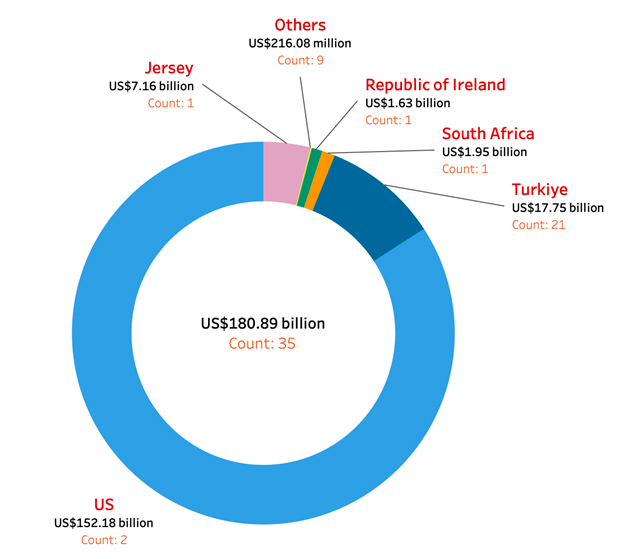
Although the US Shariah industry is underdeveloped compared to many of the world's leading Islamic financial centers, it held the single largest share of commodity AuM tracked by the IFN Investor Funds Database.
With only two funds in the space, combined US assets at the end of Q3 2025 stood at US$152.18 billion – almost 85% of the global total of US$180.89 billion.
Turkiye came in second with 21 commodity funds holding a consolidated US$17.75 billion.
In third ranking was the tax-neutral island of Jersey, with US$7.16 billion held by a solitary fund.
Far behind, in fourth and fifth places, respectively, were South Africa and the Republic of Ireland. Like Jersey, each operated a single fund, with respective AuM of US$1.95 billion and US$1.63 billion.
Nine other funds without domicile listings made up the balance of US$216.08 million in global commodity assets.
Chart: Shariah compliant commodity funds by domicile, fund count and AuM
Outlook
The future of the Shariah commodities market is exceptionally bright. The proliferation of ETF-styled products, which often serve long-term retirement planning, is expected to continue.
Gold will remain the cornerstone, its safe-haven status cemented by persistent geopolitical instability, including US-China tariff tensions. Beyond gold, there is "untapped potential" in other Shariah compatible commodities, which are anticipated to see price increases due to global demand and supply pressures.
Emerging trends like the integration of fintech to create more accessible digital platforms and the natural alignment of Islamic finance with ESG principles, are expected to broaden the market’s appeal to a wider, ethically conscious investor base.
While the challenge of achieving greater regulatory harmony across borders persists, the substantial opportunities for diversification position this dynamic sector as a key component in the evolving landscape of global finance.
Restricted Access
Login to continue reading (existing subscriber)
Subscribe NOW and get:
- Gain unlimited access through all key operating platforms
- Full access to all listed Islamic funds & fund profiles
- Unlimited access to all Islamic fund managers
- Access to all exclusive articles, reports, podcasts & videos
- Complimentary access to all IFN Investor Forums
