



- Australia’s superannuation system primary growth engine for Shariah opportunities
- Eight funds manage industry of US$356.48 million, delivering competitive returns
- Global agencies see double-digit expansion potential to position Australia as an Islamic hub
In the shadow of Australia’s massive AU$4.1 trillion (US$2.76 trillion) “superannuation” retirement industry total as at March 2025, a high-conviction Shariah compliant sector is finally asserting its financial dominance.
Under Australian law, employers must contribute 11.5% of an employee's earnings into a superannuation fund.As a captive capital pool for the nation’s 800,000 plus Muslims, this compulsory system creates an immediate demand for Halal investment vehicles.
Islamic superannuation funds bridge this gap with portfolios that mirror the legal structure of the conventional "super" fund while adhering to Shariah principles. These funds utilize the same tax-advantaged framework as traditional accounts but pivot toward tangible assets, profit-sharing arrangements plus Sukuk to generate compliant returns.
Furthermore, the rise of ‘self-managed super funds’ has allowed sophisticated investors to take direct control over their Shariah compliance. This segment has become a significant driver for the broader market, as it enables individuals to bypass conventional banking debt and invest directly in Shariah-screened equities and real estate.
As the Muslim population continues to grow at a rate outfacing the national average, the superannuation industry remains the primary engine of growth for Australia's Shariah compliant investment sector. This mandatory inflow of capital ensures that the Islamic finance market is not merely a niche alternative, but a structural pillar of the Australian financial landscape.
Asset base
Australia’s Shariah finance journey began decades ago with grassroots credit unions, but the market has recently matured into a sophisticated ecosystem that consistently rivals traditional ethical investment peers in performance. S&P Global predicts this robust trajectory will persist, forecasting the industry to expand by approximately 10% to 12% through 2026.
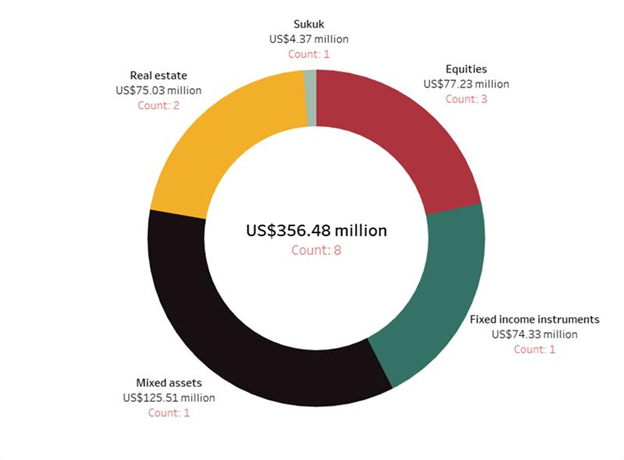
Australia’s Shariah sector is anchored by a diverse spread of asset classes, where eight distinct funds tracked by the IFN Investor Funds Database manage a combined total of US$356.48 million in AuM for Australian investors.
The heavyweight champion of this portfolio is the mixed assets class, which commands US$125.51 million in AuM through a single, highly diversified fund structure.
Equities follow closely, with three separate funds managing US$77.23 million in AuM, reflecting a strong preference for liquid, Shariah compliant stocks among the domestic Muslim population.
Real estate remains a cornerstone of the Australian narrative, boasting US$75.03 million in AuM across two funds that offer tangible security in a volatile global economy.
Meanwhile, fixed income instruments have carved out a significant space with US$74.33 million in AuM, providing a stable alternative to conventional interest-bearing bonds through a single fund.
Rounding out the national portfolio is the Sukuk market, which, despite having only one fund, manages US$4.37 million in AuM as an essential tool for institutional diversification.
Chart 1: Australia Shariah market by asset class, fund count and AuM
Largest funds
Hejaz Financial Services is a Shariah powerhouse that dominates almost the entire top eight rankings of Australia’s largest capitalized Islamic funds. The crown jewel of this setting is the Hejaz Global Ethical Fund with an AuM of US$125.7 million.
This is followed by the US$74.44 Hejaz Income Fund and the US$68.82 million Hejaz Equities Fund.
MCCA Asset Management’s US$65.72 million MCCA Income Fund is the only non-Hejaz entity to break the trend as the fourth largest fund.
That is followed by the US$9.43 million Hejaz Property Fund, the US$4.59 million Hejaz High Innovation Active ETF; the US$4.38 Hejaz Sukuk Active ETF and the US$3.94 Hejaz High Income Active ETF.
Table 1: Australia’s largest Shariah funds
| Rank | Fund | Manager | AuM (US$ million) |
| 1 | Hejaz Global Ethical Fund | Hejaz Financial Services | 125.7 |
| 2 | Hejaz Income Fund | Hejaz Financial Services | 74.44 |
| 3 | Hejaz Equities Fund | Hejaz Financial Services | 68.82 |
| 4 | MCCA Income Fund | MCCA Asset Management | 65.72 |
| 5 | Hejaz Property Fund | Hejaz Financial Services | 9.43 |
| 6 | Hejaz High Innovation Active ETF | Hejaz Financial Services | 4.59 |
| 7 | Hejaz Sukuk Active ETF | Hejaz Financial Services | 4.38 |
| 8 | Hejaz High Income Active ETF | Hejaz Financial Services | 3.94 |
Top performing funds
Leading the pack in quarterly performance was the Hejaz High Income Active ETF, which posted a three-month return of 5.88%. That was followed by the Hejaz Equities Fund, which delivered a 3.46% return.
In the third and fourth positions, the Hejaz Income Fund and the Hejaz Global Ethical Fund, generated returns of 1.82% and 1.68% respectively. MCCA Asset Management secured the fifth spot with its MCCA Income Fund, which returned 1.1%.
Rounding out the list, the Hejaz Sukuk Active ETF remained in positive territory with a 0.09% return.
However, the Hejaz High Innovation Active ETF and the Hejaz Property Fund faced headwinds during the period, posting negative returns of -2.01% and -4.49% respectively.
Table 2: Top performing Australian Shariah funds
| Rank | Fund Name | Fund Manager | Three-months return (%) |
| 1 | Hejaz High Income Active ETF | Hejaz Financial Services | 5.88 |
| 2 | Hejaz Equities Fund | Hejaz Financial Services | 3.46 |
| 3 | Hejaz Income Fund | Hejaz Financial Services | 1.82 |
| 4 | Hejaz Global Ethical Fund | Hejaz Financial Services | 1.68 |
| 5 | MCCA Income Fund | MCCA Asset Management | 1.1 |
| 6 | Hejaz Sukuk Active ETF | Hejaz Financial Services | 0.09 |
| 7 | Hejaz High Innovation Active ETF | Hejaz Financial Services | -2.01 |
| 8 | Hejaz Property Fund | Hejaz Financial Services | -4.49 |
Outlook
The trajectory of Australia’s Shariah sector suggests a market transitioning from a community-based niche into a sophisticated institutional asset class. Current momentum is bolstered by the mandatory nature of superannuation, which ensures a consistent, non-discretionary inflow of capital from a growing demographic.
Strength lies in the sector's performance resilience, with top funds like the Hejaz High Income Active ETF delivering robust quarterly returns of 5.88%. However, a notable weakness remains the high concentration of market share and product manufacturing within a very small number of dominant firms.
While Australia’s Shariah sector is gaining significant traction, it also remains a "frontier" player when measured against the institutional scale of the GCC Islamic markets.
Looking ahead, the sector is moving toward greater diversification as it expands beyond traditional real estate into active ETFs and global ethical equities. This evolution will likely attract non-Muslim investors seeking "ethical-plus" options, potentially doubling the addressable market for these Shariah compliant vehicles by 2030.
Future growth of the industry will also depend on its ability to maintain these competitive yields while navigating volatile interest rate environments. If the current 10% to 12% growth rate holds, the Australian Shariah market looks poised to become a significant regional hub for Islamic finance.
Restricted Access
Login to continue reading (existing subscriber)
Subscribe NOW and get:
- Gain unlimited access through all key operating platforms
- Full access to all listed Islamic funds & fund profiles
- Unlimited access to all Islamic fund managers
- Access to all exclusive articles, reports, podcasts & videos
- Complimentary access to all IFN Investor Forums
