




- Shariah stocks became surprising pocket of stability in global equities
- Downside protection, upside boom vindicates faith of Muslim investors
- Despite market advantage, headwinds will keep lid on Shariah equity appetites
Overview
In a global financial landscape recently buffeted by trade disputes and economic anxieties, Shariah compliant equity funds have emerged as a surprising pocket of stability, demonstrating a greater resilience than broader conventional market offerings.
Since the beginning of 2025, as investor unease deepened over US-triggered tariff squabbles, rising recession fears following a rare quarterly decline in American GDP, and the fragile ceasefires in Ukraine and Gaza, most risk assets endured significant losses.
The S&P 500, a benchmark of American corporate health, plummeted by nearly 18% from its 2024 close by the 5th April 2025, edging close to bear market territory. In contrast, the S&P Global BMI Shariah Index, which tracks companies adhering to Islamic finance principles, showed a comparatively smaller decline of almost 16% by the 7th April 2025.
While both indices are since up about 8% year-to-date, the downside protection during turbulent times and virtually matching upside in boom periods vindicate Muslim investors who chose faith-based investing, avoidance of interest-generating income and excessive speculation over the absolute returns promised by the conventional world.
Investment opportunity
The bedrock of Shariah compliant investing lies in its stringent screening process, which excludes businesses involved in activities deemed Haram and prohibits transactions tainted by Riba, Maysir and Gharar.
This rigorous adherence to ethical principles, some experts suggest, inadvertently builds a more defensive portfolio. Leslie Yap, country head of Nomura Asset Management (Malaysia), observed in March 2025 that this strict screening could offer superior downside protection even when compared to certain ESG models during periods of heightened market volatility.
A case in point was the performance of major interest-earning banks like JPMorgan Chase, Bank of America and Wells Fargo, whose share prices plunged in March 2025; their exclusion from Shariah compliant portfolios shielded Muslim investors from these losses.
Industries that typically align with Islamic investment criteria and thus present opportunities include technology and fintech, healthcare and pharmaceuticals, real estate and infrastructure, Halal consumer goods and food, renewable energy and sustainability, manufacturing of permissible goods, agriculture plus shipping and logistics.
Regulatory framework
The expanding global interest in ethical investing, combined with a progressively accommodating regulatory landscape – particularly in North America – has provided a fertile ground for Shariah compliant investing.
The continuous development of Islamic financial infrastructure, coupled with the rapid integration of fintech and digitalization, is further expanding the reach and appeal of Shariah compliant equity funds globally. These factors are instrumental in fostering a more robust and accessible environment for this niche asset class.
Asset spread
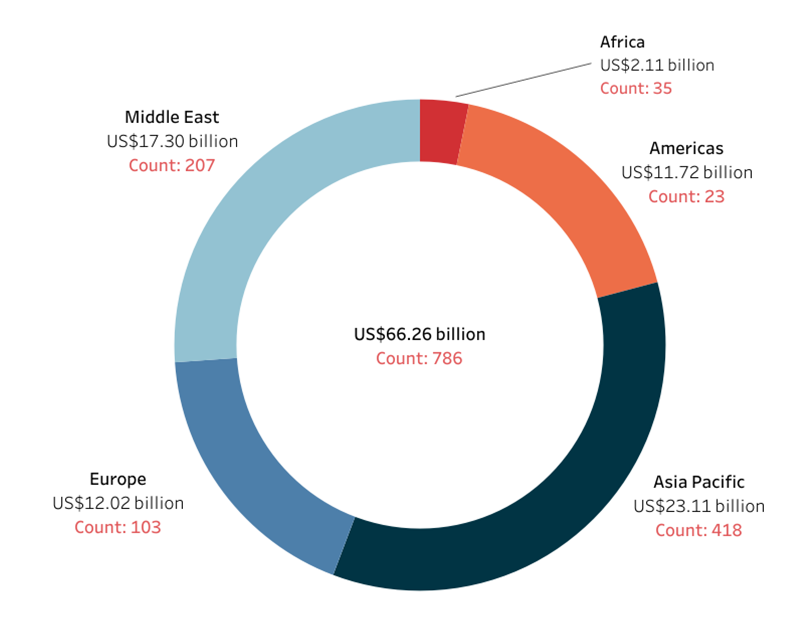
Geographically, Asia Pacific dominates the Islamic equity fund landscape, boasting the highest number of funds tracked globally by the IFN Investor Funds Database. At the end of Q2 2025, there 418 Shariah compliant equity funds in the region, with AuM of US$23.11 billion.
Asia Pacific’s domination of the asset class is largely due to Malaysia and Indonesia becoming hubs for Islamic finance with their Muslim-majority populations.
Europe – with Muslim hubs Luxembourg, UK and Ireland – ranks second for Islamic equity funds. The IFN Investor Funds Database reports 103 funds and US$12.02 billion in AuM for the region, driven by demand for ESG, globalization and fintech innovation.
The Middle East, while having fewer Shariah compliant equity funds (207), holds a higher AuM than Europe at US$17.3 billion. Elsewhere in the world with significant Islamic equity fund activity are the Americas (23 funds with US$11.72 billion) and Africa (35 funds with US$2.11 billion in AuM).
Asia Pacific also demonstrated the strongest percentage growth in Islamic equity AuM from Q1 2025 to Q2 2025, expanding at a rate of 42.96% that took valuations in the asset class from US$16.17 billion to US$23.11 billion.
The Americas saw substantial growth in this area too, with AuM rising 21.19% between Q1 2025 to Q2 2025. Africa's AuM grew 16.07% for the period while Europe's AuM expanded 15.63%. The Middle East experienced the slowest growth in this respect at 1.38%.
Table 1: Shariah-focused equity AuM growth by quarter
| Region | AuM Q1 2025 (US$ billion) | AuM Q2 2025 (US$ billion) | Change (%) |
| Asia Pacific | 16.17 | 23.11 | 42.96% |
| Americas | 9.67 | 11.72 | 21.19% |
| Africa | 1.82 | 2.12 | 16.07% |
| Europe | 10.39 | 12.02 | 15.63% |
| Middle East | 17.06 | 17.3 | 1.38% |
Chart 1: Shariah-focused equity funds by region
Fund AuM, performance
HSBC Asset Management tops the five largest Shariah money managers in equity funds tracked by the IFN Investor Funds Database. The UK-based global money manager had US$4.15 billion in its HSBC UCITS Common Contractual Fund’s Islamic Global Equity Index Fund as at the end of Q2 2025.
Indonesia’s Bahana TCW Investment Management is second largest, with US$3.26 billion in its Bahana USD Global Shariah Equities fund.
Bahana is followed by Saturna Capital’s US$3.02 billion Amana Growth Institutional Fund, the US$2.89 billion Bahana US Opportunity Sharia Equity Fund and the US$2.49 billion Amana Growth Investor Fund.
Table 2: Largest Shariah equity funds at the end of Q2 2025
| Rank | Fund | Manager | AuM (US$ million) |
| 1 | HSBC UCITS Common Contractual Fund - Islamic Global Equity Index Fund - Class A2CGBP | HSBC Asset Management | 4,147.49 |
| 2 | Bahana USD Global Sharia Equities | Bahana TCW Investment Management | 3,259.4 |
| 3 | Amana Growth Institutional Fund | Saturna Capital | 3,020 |
| 4 | Bahana US Opportunity Sharia Equity USD | Bahana TCW Investment Management | 2,887.92 |
| 5 | Amana Growth Investor Fund | Saturna Capital | 2,490 |
| 6 | Albilad CSOP MSCI Hong Kong China Equity ETF | Albilad Capital | 1,344.52 |
| 7 | Amana Income Institutional Fund | Saturna Capital | 1,240 |
| 8 | SP Funds S&P 500 Sharia Industry Exclusions ETF | ShariaPortfolio | 1,087 |
| 9 | Bahana Global Healthcare Sharia USD Equity Fund | Bahana TCW Investment Management | 1,013.47 |
| 10 | Public Ittikal Sequel Fund | Public Mutual | 974.03 |
The best of the top five performing Shariah equity funds was Henan Putihrai Asset Management’s HPAM Ekuitas Syariah Berkah, with a three-month return of 27.67%. HPAM says its objective is to achieve attractive long-term capital growth through investments in Shariah instruments in the capital and money markets.
US-based Franklin Templeton’s Franklin Shariah Technology Fund was second best, with a 27.58% return during the same period.
BSF Capital’s Al Qasr GCC Real Estate & Construction Equity Trading Fund was third with 25.75%, followed by BRI Manajemen Investasi of Indonesia’s BRI Indeks Syariah (23.27%) and the Active Portfolio Technology Participation Fund of Turkiye’s Aktif Portfoy (23.13%).
Table 3: Shariah equity funds by three-month returns
| Rank | Fund | Manager | Three-month returns (%) |
| 1 | HPAM Ekuitas Syariah Berkah | Henan Putihrai Asset Management | 27.67 |
| 2 | Franklin Shariah Technology Fund | Franklin Templeton | 27.58 |
| 3 | Al Qasr GCC Real Estate & Construction Equity Trading Fund | BSF Capital | 25.75 |
| 4 | BRI Indeks Syariah | BRI Manajemen Investasi | 23.27 |
| 5 | Active Portfolio Technology Participation Fund | Aktif Portfoy | 23.13 |
Outlook
The performance of Shariah compliant equity funds will remain under the microscope, particularly if the current market headwinds, such as those stemming from tariff pressures, persist.
However, the inherent defensive characteristics of these investments are expected to continue offering a crucial relative advantage. The potential for continued outperformance hinges on market trends that favor the distinct ethical and investment constraints embedded within Islamic finance. As global economic uncertainties loom, Shariah compliant equities present a compelling investment avenue for those seeking a potentially more stable and values-aligned approach to navigating the market's complexities. Investors are advised to pay close attention to specific sectoral exposures and geographical diversification, as these elements will ultimately shape returns.
Restricted Access
Login to continue reading (existing subscriber)
Subscribe NOW and get:
- Gain unlimited access through all key operating platforms
- Full access to all listed Islamic funds & fund profiles
- Unlimited access to all Islamic fund managers
- Access to all exclusive articles, reports, podcasts & videos
- Complimentary access to all IFN Investor Forums
