




- Middle East, Asia Pacific regions dominate AuM
- Double-digit Q3 2025 returns for top mixed asset funds
- Significant growth prospects in Europe and the Americas
Overview
The Shariah compliant mixed assets sector has emerged as a resilient and increasingly global segment of ethical finance, serving as a vital barometer for investor demand that prioritizes both growth and principle.
Data compiled from the IFN Investor Funds Database reveals that the sector – which combines equities, fixed income, real estate and commodities – continues to anchor significant capital while witnessing dynamic growth in new markets beyond traditional strongholds.
The gravitational center of the industry, unsurprisingly, remains firmly planted in the Middle East and Southeast Asia. These regions collectively dominate the landscape, accounting for the lion’s share of AuM and hosting the vast majority of dedicated Shariah funds.
The robust concentration of capital here reflects mature domestic markets, where institutions and individual investors alike have long relied on these diversified products – which typically balance equity investments with fixed-income instruments like Sukuk – for stability and long-term capital preservation. The sheer scale of AuM in these hubs underscores the deeply integrated nature of Islamic finance within the regional economies, suggesting both stability and confidence among core investors.
However, a subtle yet significant shift is detectable when examining the growth trajectory in Western jurisdictions. Europe, in particular, has seen a notable increase in its Shariah mixed assets fund count, even if its total AuM remains comparatively modest against the established Asian giants.
This trend signals a powerful democratization of Shariah compliant investing, driven by a growing, educated diaspora – alongside non-Muslim investors seeking genuinely ethical, asset-backed alternatives to conventional finance. The launch of new funds in London, Frankfurt and other financial capitals illustrates that the structural demand for ethical, diversified portfolios is no longer localized but is becoming a key component of the global investment narrative.
In North America, the market remains nascent but had the largest Q3 2025 growth, explaining the strategic effort by fund managers to tap into the world's largest capital market.
Asset spread
Analysis of the regional distribution reveals a strong concentration of funds in markets where retail participation and accessible fund structures are prioritized.
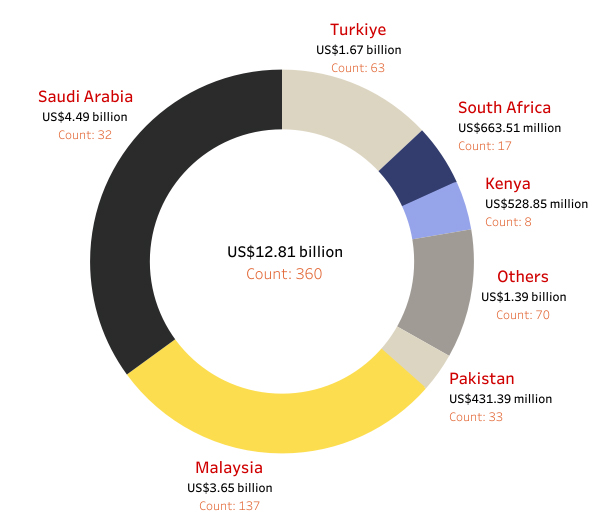
The Asia Pacific region, with Islamic powerhouses Malaysia and Pakistan, stands out as the global leader in fund count, representing 208 Shariah mixed asset funds. This suggests a mature market with a high degree of product availability tailored to individual investors and smaller institutional mandates. Malaysia’s 137 funds are worth a total of US$3.65 billion, dwarfing Pakistan’s 33 funds valued at US$431.39 million.
Yet, despite leading in fund count, this region accounts for only US$4.8 billion in total AuM. That gives it a 37% share of the global US$12.81 billion tracked by the IFN Investor Funds Database and a number two ranking for this asset class.
The Middle East, with only 44 funds, ranks highest in sectoral AuM though its advantage over the Asia Pacific region is only marginal, at US$4.99 billion or 39% of total market share.
This disparity highlights a key structural difference: Asia Pacific has a high number of smaller, retail-focused funds while the Middle East with GCC heavyweights like Saudi Arabia and UAE are led by a smaller number of large, institutional or sovereign wealth funds that carry significantly higher average funding. Saudi Arabia itself has 32 funds that account for US$4.49 billion.
Chart 1: Shariah mixed assets by region, fund count and AuM
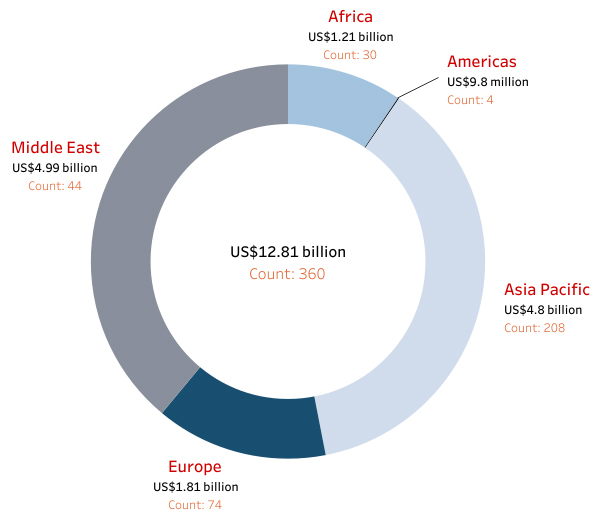
The remaining major global markets including Europe and Africa, are significant in AuM and fund count.
Europe, with 74 funds, represents an AuM of US$1.81 billion, or 14% of the world’s total. The region leverages its established financial hubs like the UK and Luxembourg to cater to sophisticated institutional mandates and a growing, affluent diaspora seeking diversified ethical investments.
This substantial presence, though smaller than the Asian giants, confirms the universality of the Shariah mixed asset model, demonstrating that ethical finance is now a permanent feature of Western capital markets. Turkiye leads the European region with 63 funds worth US$1.67 billion.
Bridging the geographic gap between the established European and Middle Eastern markets is the emerging region of Africa. While smaller in scale, the continent's growing regional financial centers, driven by countries like South Africa and Nigeria, are home to 30 funds, contributing US$1.21 billion or 9% to the global mixed asset AuM.
This segment is distinct, often characterized by a focus on domestic or regional mandates to mobilize local liquidity, and represents a crucial future growth vector for the mixed asset class. South Africa’s 17 funds worth US$663.51 million and Kenya’s eight funds valued at US$528.85 million lead on this front.
Meanwhile, the Americas represent a strategically significant, if still fragmented, landscape, accounting for just four funds with a total AuM of US$9.8 million. Within this context, the US – despite being home to the world’s largest and deepest capital markets – currently occupies the position of the smallest regional player with just eight funds and a corresponding minimal share of total AuM.
This smaller, concentrated footprint in the US highlights the specific challenges – from regulatory hurdles to market education – that still exist in fully integrating these ethical and asset-backed products into the mainstream North American financial architecture.
Chart 2: Shariah mixed assets by region, fund count and AuM
Key growth areas
Starting from a much smaller base, Shariah mixed assets growth in the Americas posted a 27.6% increase in total AuM between the second and third quarters of this year. Europe follows closely, recording a 17.41% jump in AuM.
In contrast, the two largest markets exhibited steadier, more predictable growth commensurate with their massive scale. The Asia Pacific region, the global leader in fund count, posted a solid 8.61% gain, confirming persistent retail and institutional confidence across powerhouses like Malaysia and Pakistan.
Similarly, the Middle East, home to the world’s largest average fund sizes, continued its upward trajectory with a respectable 5.08% growth rate, reflecting the stability of its institutional asset base.
The most notable outlier in the quarter was Africa, which saw its total AuM contract by 4.39%.
Table 1: Fastest growing regions for mixed assets
| Region | AuM Q2 2025 (US$ million) | AuM Q3 2025 (US$ million) | Change (%) |
| Africa | 1,269.24 | 1,213.57 | -4.39 |
| Americas | 7.68 | 9.8 | 27.6 |
| Asia Pacific | 4,450.15 | 4,833.37 | 8.61 |
| Europe | 1,538.68 | 1,806.61 | 17.41 |
| Middle East | 4,749.45 | 4,990.66 | 5.08 |
Largest mixed asset funds
The list of the largest mixed asset funds is overwhelmingly led by Al Rajhi Capital from Saudi Arabia, which commands three of the top 10 positions. The flagship Al Rajhi Growth Fund alone holds a staggering US$2.224 billion in AuM, a figure that is nearly four times the size of the next largest fund, setting the benchmark for institutional scale in the industry.
The remaining top ranks are heavily populated by Malaysian funds managed by Prudential BSN Takaful (US$656.62 million), Public Mutual (US$586.13) and Principal Asset Management (US$250.5 million). Others are the Lapfund Amal Fund (US$510.05 million) and the Islamic Balanced Fund (US$285.73 million) from managers in Africa, as well as a large fund from Turkiye Hayat Ve Emeklilik in Turkiye.
Table 2: Largest mixed asset funds
| Rank | Fund | Manager | AuM(US$ million) |
| 1 | Al Rajhi Growth Fund | Al Rajhi Capital | 2,224.04 |
| 2 | Takafulink Dana Ekuiti | Prudential BSN Takaful | 656.62 |
| 3 | Public Islamic Asia Tactical Allocation Fund | Public Mutual | 586.13 |
| 4 | Al Rajhi Monthly Distribution Fund | Al Rajhi Capital | 530.36 |
| 5 | Lapfund Amal Fund | Lapfund | 510.05 |
| 6 | Al Rajhi Monthly Distribution Fund 2 | Al Rajhi Capital | 411.54 |
| 7 | Public Islamic Mixed Asset Fund | Public Mutual | 302.1 |
| 8 | Islamic Balanced Fund | Camissa Asset Management | 285.73 |
| 9 | Principal Islamic Lifetime Balanced Fund | Principal Asset Management | 250.5 |
| 10 | Turkiye Life And Retirement Participation Contribution Retirement Investment Fund | Turkiye Hayat Ve Emeklilik | 233.66 |
Top performing mixed asset funds
The top-performing funds over the three-month period revealed a diverse geographical spread of excellence. Leading the global leaderboard was the Lotus Halal Investment Fund, managed by Lotus Capital, which delivered a stellar 11.88% return. This performance highlights the capability of managers operating in emerging markets to capture significant value.
Closely following were the target-date offerings from ShariaPortfolio – the SP Funds 2040 Target Date Fund (Institutional) and its Investor class – which posted remarkable returns of 11.55% and 11.44%, respectively. The strong showing of these US-based funds provides critical validation for the North American market, proving that Shariah compliant long-term savings vehicles can compete aggressively with conventional counterparts.
The list is rounded out by the Aditum Islamic Income and Growth Fund Open Ended IC Plc, managed by Aditum Investment Management, achieving an 11.01% return, and the RHB Retirement Series – i-Allocator Fund from RHB Asset Management, which secured a 10.71% return.
Table 3: Top performing mixed asset funds
| Rank | Fund | Manager | Three-months return (%) |
| 1 | Lotus Halal Investment Fund | Lotus Capital | 11.88 |
| 2 | SP Funds 2040 Target Date Fund – Institutional | ShariaPortfolio | 11.55 |
| 3 | SP Funds 2040 Target Date Fund – Investor | ShariaPortfolio | 11.44 |
| 4 | Aditum Islamic Income and Growth Fund Open Ended IC Plc | Aditum Investment Management | 11.01 |
| 5 | RHB Retirement Series – i-Allocator Fund | RHB Asset Management | 10.71 |
Outlook
The Shariah mixed asset class is an essential strategic tool, serving as the bridge between the high growth potential of equities and the stability of Sukuk.
Its moderate positioning and focus on diversification make it indispensable for conventionalizing Shariah portfolios and broadening the appeal of Islamic finance to a wider, risk-aware investor base.
Looking ahead, the sector is poised to leverage both the Western demand for ethical finance and the inherent stability of asset-backed instruments to navigate global economic volatility.
Continued product innovation, particularly through tech-enabled distribution and specialized target-date funds, will be the key drivers in cementing the mixed asset fund as the cornerstone of global Islamic wealth management.
Restricted Access
Login to continue reading (existing subscriber)
Subscribe NOW and get:
- Gain unlimited access through all key operating platforms
- Full access to all listed Islamic funds & fund profiles
- Unlimited access to all Islamic fund managers
- Access to all exclusive articles, reports, podcasts & videos
- Complimentary access to all IFN Investor Forums
