




Real estate: Middle East still the bastion, but Asia Pacific closing in
- Middle East dominates 60% of global Shariah real estate public funds
- Loyal institutional and retail investors insulate region from capital flights
- Sector needs to move from opaque holdings to regulated, transparent vehicles
As the Middle East faces one of its greatest geopolitical tests ever, multiple questions are swirling about its future, including that of multi-billion-dollar properties dotting the GCC skyline from Riyadh to Dubai and Doha.
Some anticipate that a strategic recalibration by Gulf-based high-net-worth individuals may occur, with Asia Pacific destinations such as Singapore and Kuala Lumpur looking poised to benefit – particularly from short-term capital flights.
Yet, history suggests a regional endurance that will likely see the GCC region ride out this crisis, supported by loyal institutional and faith-aligned investors who form the bedrock of its stability.
The financials of the Middle East as the bastion of Shariah real estate speak for themselves. As of Q4 2025, this region accounted for more than 60% of global assets in Islamic properties and related instruments in public funds tracked by the IFN Investor Funds Database, amounting to an AuM of US$15.25 billion from the worldwide total of US$24.89 billion.
There are 38 Islamic real estate funds tracked in the GCC region by this exclusive database, nearly half of the global number of 78. The average assets for a fund, valued at US$480 million, is eight times that in Europe’s competing Shariah model.
Such growth did not come in a vacuum. While industry watchers often point to the Middle East as a natural habitat for Shariah real estate investment, developments like the UAE’s Palm Jumeirah, Doha’s Qatar Pearl and Saudi Arabia’s upcoming futuristic city NEOM have attracted some of the West’s biggest investors seeking both equity and sustainable returns in the ethical world’s most iconic properties.
Financial disclosures from listed REITs on the Tadawul and Dubai Financial Market, along with regulatory updates from the Saudi Capital Market Authority and the UAE Securities and Commodities Authority point to a regional market with much promise going for it – despite the current crisis.
As of Q4 2025, Saudi Arabia led the region with US$8.23 billion in AuM spread across 27 funds. The UAE, the other regional powerhouse, had the largest asset concentration per fund, with four entities accounting for US$5.96 billion. Kuwait, the third in the region’s pecking order for real estate, had a mere three funds sharing a significant capital base of US$522.77 million.
The growing dynamism of the Shariah property sector in the Middle East will be crucial to back up the near-term projections made for the Islamic investments universe. With S&P Global projecting global Islamic finance assets to reach US$9.7 trillion by 2029, the real estate sector is strategically positioned to capture a larger share of the expanding capital pool as more investors hunt for asset-backed wealth creation.
Assets spread
Aside from the Middle East, four other regions account for the Shariah real estate money that traverses the world:
Asia Pacific – Ranked second in the IFN Investor Funds Database in Q4 2025, this region had US$8.39 billion spread across 21 Shariah real estate funds. That puts the average fund capitalization at US$400 million, just behind the Middle East’s US$480 million.
Malaysia, a global leader in Islamic finance, leads this region with US$8.06 billion in 11 funds. Malaysian Islamic REITs – or i-REITs – have set the global benchmark for Shariah compliant property investment, transforming a traditionally illiquid asset class into a transparent, accessible and high-yield vehicle that serves as the gold standard for faith-aligned capital markets. With its long-term strategic planning, robust regulatory framework and advanced expertise in product innovation, the country has successfully established itself as a premier international hub for faith-aligned investments.
Indonesia, while operating at a different stage of development than its neighbor, presents a compelling growth narrative driven by demographic scale and an accelerating "Shariah reset" among its youth population. With the world’s largest Muslim-majority population, Indonesia’s real estate sector is witnessing a surge in interest for faith-based housing, which offers a solution for consumers seeking ownership schemes that strictly adhere to ethical, interest-free principles.
Europe – The third largest region for Islamic real estate assets is a bifurcated market with 16 funds and total AuM of US$951.15 million. While there are some concentrated pools of capital, the European Shariah real estate funds market on the whole is fragmented, with a higher density of smaller, specialized vehicles.
Turkiye stands out as a critical node within this European network, with 14 funds managing US$935.37 million, or 98% of the region’s total. But Europe as a Shariah real draw is also growing beyond Ankara’s Real Estate Investment Funds (REIFs).
George Colley, managing director at Al-Jisr, a Shariah-focused boutique firm that bridges GCC money with London real estate, recently shared with IFN Investor that the traditional "safe haven" allure of London real estate might matter more than ever for Gulf investors if war grips more of the Middle East. While the glitz of Riyadh’s skyline and the aggressive yields of the GCC are powerful attractions, Europe’s relative political stability – albeit “boring” returns – can resonate with investors wanting to preserve their money as much as grow it, reasoned George.
Chart 1: Islamic real estate assets by region, AuM and fund count
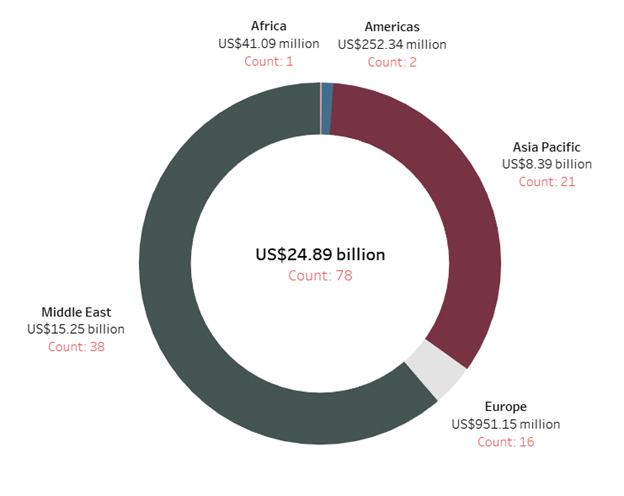
Americas – There were only two US-led Shariah entities in North America tracked by the IFN database as of Q4 2025, and they jointly accounted for an AuM of US$252.34 million. While they aren’t representative of the typical US dominance in global finance, North American Shariah public funds have been quietly adapting to Islamic real estate structures. Such funds, lacking the history and pedigree of their GCC peers, have been able to attract institutional money by promising liquidity and rigorous compliance through sophisticated REITs and PE offerings.
Africa – Unlike the fragmented, specialized hubs of Europe, Africa’s Shariah real estate funds sector is largely driven by its massive infrastructure deficit and the need for inclusive development. With an AuM of US$41.09 million operated by just one fund, the continent’s Islamic real estate sector is a work in progress – like the rest of its ethical market.
Nigeria, with its large Muslim population and sophisticated regulatory framework, is leading the region. Sudan remains a cornerstone due to its predominantly Shariah compliant banking system, while South Africa has become a key player in Islamic asset management. Emerging centers such as Kenya, Egypt, Morocco and Ghana are also rapidly gaining traction, supported by new legislation and fintech-driven financial inclusion initiatives.
Chart 2: Islamic real estate assets by country, AuM and fund count
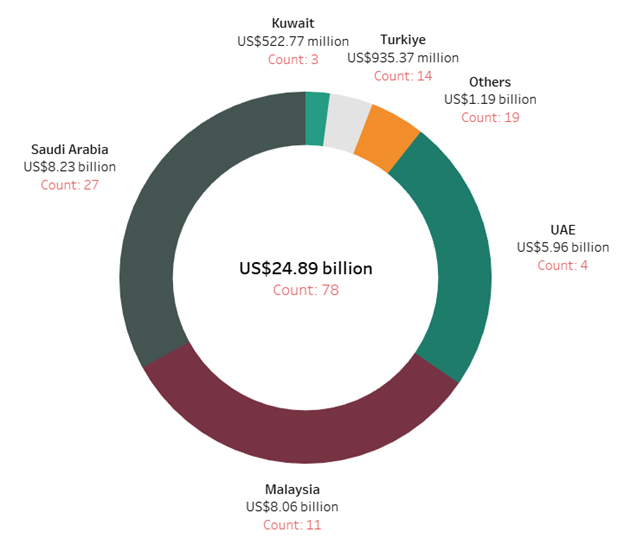
Table 1: Quarterly percentage change in Islamic real estate AuMs
| Region | Q3 2025 (AuM US$ million) | Q4 2025 (AuM US$ million) | AuM change (%) |
| Africa | 40.97 | 41.09 | 0.29 |
| Americas | 230.67 | 252.34 | 9.39 |
| Asia Pacific | 8,435.43 | 8,391.2 | (0.52) |
| Europe | 849.45 | 951.15 | 11.97 |
| Middle East | 14,913.87 | 15,254.46 | 2.28 |
| Total | 24,470.4 | 24,890.23 | 1.72 |
Largest capitalized real estate funds
DHAM REIT Management’s Dubai Residential REIT was the largest capitalized Shariah real estate fund for Q4 2025, with an AuM of US$4.778 billion. A closed-ended fund listed on the Dubai Financial Market, it distinguishes itself as the GCC’s first "pure-play" residential leasing REIT, focusing exclusively on managing and owning residential real estate assets.
Table 2: Islamic Real estate funds by AuM
| Rank | Fund | Manager | AuM (US$ million) |
| 1 | Dubai Residential REIT | DHAM REIT Management | 4,778.87 |
| 2 | KLCC REIT | KLCC Property Holdings | 4,702.81 |
| 3 | Axis-REIT | Axis-REIT Managers | 1,350.32 |
| 4 | Amanah Hartanah Bumiputera | Pelaburan Hartanah | 1,261.28 |
| 5 | Emirates REIT | Equitativa Group | 886 |
| 6 | Al Rajhi REIT Fund | Al Rajhi Capital | 847.95 |
| 7 | Jadwa REITs Fund | Jadwa Investment | 758.67 |
| 8 | Jadwa REIT Saudi fund | Jadwa Investment | 743.76 |
| 9 | Bonyan REIT | Saudi Fransi Capital (BSF Capital) | 574.71 |
| 10 | Alkhabeer REIT Fund | Alkhabeer Capital | 540.05 |
Top performing real estate funds
Turkiye’s Ziraat Portfoy was the manager of the most successful Shariah real estate fund in Q4 2025, with its Ziraat Portfolio Management Bgf Participation Private REIF returning 30.04%. Ziraat Portföy itself is the asset management arm of the Ziraat Finance Group. As of early 2026, the company reported managing three REIFs.
Table 3: Top Islamic real estate funds by three-month returns
| Rank | Fund | Manager | Three-month returns (%) |
| 1 | Ziraat Portfolio Management Bgf Participation Private Real Estate Investment Fund | Ziraat Portfoy | 30.04 |
| 2 | Isra Real Estate And Venture Capital Portfolio Management Inc. V Metroway Participation Real Estate Investment Fund | Isra Portfoy | 16.22 |
| 3 | Isra Real Estate And Venture Capital Portfolio Management Inc. V Mall Istanbul Participation Venture Capital Investment Fund | Isra Portfoy | 15.47 |
| 4 | Albaraka Portfolio Real Estate Participation Short Term Participation Free (TL) Fund | Albaraka Portfoy | 9.52 |
| 5 | Albaraka Portfolio Management Bereket Participation Real Estate Investment Fund | Albaraka Portfoy | 5.58 |
| 6 | Riyad REIT | Riyad Capital | 5.38 |
| 7 | Markaz Real Estate Fund | Markaz (Kuwait Financial Center) | 3.58 |
| 8 | Albilad Fund of REIT Fund | Albilad Capital | 2.89 |
| 9 | KFH Capital REIT Fund | KFH Capital | 2.64 |
| 10 | Global Sharia REITS Portfolio | Invesense Asset Management | 2.1 |
Outlook
As investors hunt for asset-backed wealth, the real estate sector is set to capture a larger share of this capital pool. However, the immediate outlook is tempered by the profound geopolitical test currently gripping the Middle East, which is forcing many to consider a tactical recalibration of capital toward neutral "safe havens" like Singapore and London.
Even if the crisis accelerates the diversification of portfolios into established Asian and European markets as inventors try to hedge against a Middle East contagion, the Middle East will likely remain the bastion of the region’s Shariah real assets. There is enough history of endurance and loyalty to back this.
Ultimately, the transition from opaque private holdings to regulated, transparent vehicles like i-REITs will be the primary catalyst in ensuring the sector remains resilient, transforming real estate into an "all-weather" hub for global faith-aligned investments.
Restricted Access
Login to continue reading (existing subscriber)
Subscribe NOW and get:
- Gain unlimited access through all key operating platforms
- Full access to all listed Islamic funds & fund profiles
- Unlimited access to all Islamic fund managers
- Access to all exclusive articles, reports, podcasts & videos
- Complimentary access to all IFN Investor Forums
