




- Growing market that remains at a fraction of conventional money market
- Relative money market size underscores Muslim nations’ cash reserves
- Future still promising amid steady hand of money market, ethical investing demand
Overview
In a global financial landscape often defined by volatility and speculative fervor, a quieter, principled corner of the market is steadily making its mark. The Shariah money market, a subset of the broader Islamic finance universe, operates on a foundation of ethical principles, offering investors an alternative to the conventional system.
While it remains a fraction of the conventional market's colossal size, its recent performance and growing sophistication hint at a promising, albeit calmer, trajectory.
The Islamic money market is a tale of both challenge and promise. Its size, while growing, underscores the hurdles financial institutions in many Muslim nations face in efficiently managing their short-term cash reserves.
At the close of Q2 2025, the IFN Investor Funds Database tracked 255 funds in the space, with a combined AuM of US$37.7 billion. This is a modest step up from the US$37.25 billion in Q1 2025, with the number of funds being unchanged.
To put this in perspective, US conventional money market funds alone hold trillions of dollars in assets, highlighting the Islamic money market's relative modesty within the global financial system.
Challenges
For a corner of the financial world often heralded for its dynamism, the Islamic money market presents a paradox: its relatively modest size highlights a persistent struggle for institutions in many Muslim-majority nations to manage their short-term cash reserves. A key factor is the limited availability of high-quality, dollar-denominated financial instruments designed for cross-border liquidity management.
The landscape is also shaped by fragmented domestic approaches. While countries like Malaysia have cultivated a mature, multifaceted Islamic money market, many other regions are still in nascent stages. Malaysia and the UAE are also notable for their issuance of Islamic Treasury bills.
In the GCC, major players like Saudi Arabia and Bahrain rely heavily on commodity Murabahah for their liquidity needs, while Europe’s Islamic finance hubs – such as Luxembourg – have turned to mutual funds as a primary alternative to traditional money market instruments.
Meanwhile, in parts of Africa and the Americas, the development of these markets is still in its infancy, hindered by underdeveloped financial infrastructure and a lack of comprehensive regulatory support. This patchwork of regulatory environments and varying interpretations of Shariah has resulted in instruments like Commodity Murabahah being a popular liquidity tool in some countries – including Malaysia, Bahrain, Bangladesh, Pakistan, Brunei, Indonesia and Qatar – but not universally adopted.
Investment opportunity
For an investor seeking stability and ethical alignment, the Islamic money market offers a compelling proposition. Despite the complexities of adhering to both financial and religious compliance, money market players tracked by the IFN Investor Funds Database have delivered returns in an annual range of 4-4.5% since the start of the year, keeping pace with their conventional counterparts.
Globally, the most prominent hubs for Islamic finance – and by extension, its money market – are dynamic cities like Dubai, Kuala Lumpur, London, Manama and Riyadh. These centers have become fertile ground for industry, thanks to forward-thinking regulatory environments and a deep pool of expertise.
The story of the Islamic money market is told not just in dollars, but in geography. It’s a narrative of regional hubs, with the Middle East emerging as the undisputed powerhouse.
As of the end of Q2 2025, the region commanded the highest combined AuM according to data tracked by the IFN Investors Fund Database, tallying US$21.11 billion from 51 funds. This is a remarkable share of the global AuM of US$37.7 billion spread across 255 funds.
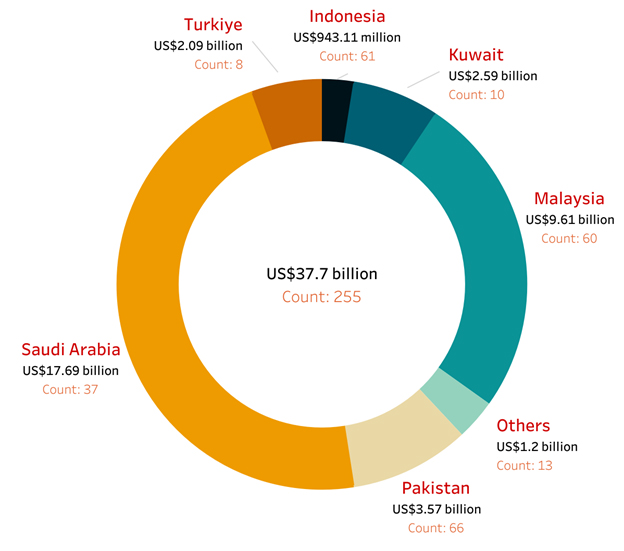
Leading the charge in the Middle East is Saudi Arabia, which alone accounts for a lion's share of the region’s dominance with US$17.69 billion in AuM across 37 funds.
Meanwhile, Asia Pacific offers a different – yet equally compelling – picture. The region boasts the highest number of Islamic money market funds in the world, with 189.
These funds collectively hold a gross value of US$14.14 billion. Within this dynamic region, Pakistan stands out for its sheer volume, hosting the largest number of funds at 66, which are valued at US$3.57 billion. However, it is Malaysia that holds this region’s crown for AuM, with its 60 funds accounting for a commanding US$9.61 billion.
Chart 1: Islamic money market fund count and AuM by region
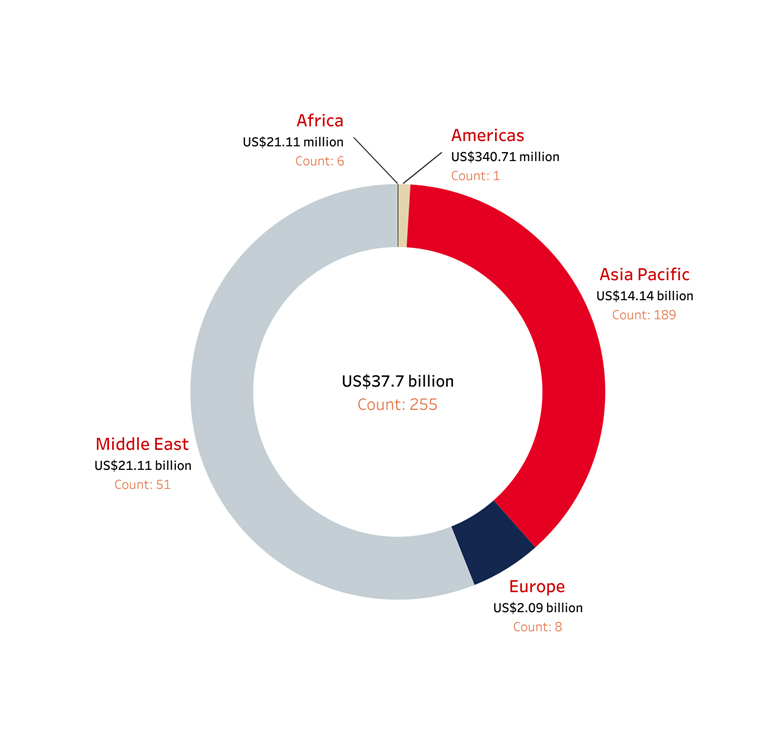
Chart 2: Top Islamic money market fund jurisdictions
Fund performance
A look at the top performers in Q2 2025 reveals a vibrant, competitive landscape. The Artal Muharaba Fund (Class A) leads the pack with a three-month return of 5.79%, followed closely by the Yaqeen SAR Murabaha Fund at 5.53%. Other high-flyers include the ANB Capital SAR Trade Fund (5.29%), the SAB Invest Saudi Riyal Murabaha Fund (4.9%) and the SAB Invest Saudi Riyal Money Market Fund (4.65%).
Table 1: Top performing Islamic money market funds by three-month returns
| Rank | Fund | Manager | Three-month returns (%) |
| 1 | Artal Muharaba Fund (Class A) | Artal Capital | 5.79 |
| 2 | Yaqeen SAR Murabaha Fund | Yaqeen Capital | 5.53 |
| 3 | ANB Capital SAR Trade Fund | ANB Capital | 5.29 |
| 4 | SAB Invest Saudi Riyal Murabaha Fund | SAB Invest | 4.9 |
| 5 | SAB Invest Saudi Riyal Money Market Fund | SAB Invest | 4.65 |
The sheer scale of some of these funds is equally impressive. The Al Rajhi Awaeed Fund is a behemoth with an AuM of US$5 billion, while the SNB Capital Al Sunbullah SAR holds a significant US$4.37 billion. These large players demonstrate the market's capacity to manage substantial capital.
Table 2: Largest Islamic money market funds by AuM
| Rank | Fund | Manager | AuM (US$ million) |
| 1 | Al Rajhi Awaeed Fund | Al Rajhi Capital | 5,004.44 |
| 2 | SNB Capital Al Sunbullah SAR | SNB Capital | 4,368.09 |
| 3 | AHAM Aiiman Money Market Fund | AHAM Capital Asset Management | 3,286.8 |
| 4 | Alpha Murabaha Fund | Alpha Capital | 1,401.19 |
| 5 | Watani KD Money Market Fund II | NBK Wealth | 1,308.25 |
| 6 | Principal Islamic Deposit Fund - Class AI | Principal Asset Management | 1,182.4 |
| 7 | Kuveyt Turk Portfolio Short-Term Participation Free (TL) Fund | Kuveyt Turk Portfoy | 1,155.83 |
| 8 | Riyad SAR Liquidity Fund | Riyad Capital | 997.83 |
| 9 | Boubyan KD Money Market Fund II | Boubyan Capital | 875.28 |
| 10 | ANB Capital SAR Trade Fund | ANB Capital | 863.05 |
Table 3: Quarterly percentage change in money market AuM by region
| Region | Q1 2025 (US$ million) | Q2 2025 (US$ million) | Change (%) |
| Africa | 19.02 | 19.63 | 3.1 |
| Americas | 316.12 | 340.71 | 7.22 |
| Asia Pacific | 13,560.42 | 14,136.87 | 4.08 |
| Europe | 2,058.62 | 2,086.33 | 1.33 |
| Middle East | 21,088.83 | 21,113.1 | 0.11 |
Outlook
The outlook for the Islamic money market is promising, driven by its stability and the growing global appetite for ethical investments.
While it is significantly shallower than its conventional counterpart – with a combined AuM of US$37.7 billion as tracked by the IFN Investor Funds Database compared to the trillions of dollars in US non-Islamic money market funds – this relative modesty is a function of its principled, asset-backed foundation.
While the sector’s returns may not always "outperform" in bullish periods, its stable annual returns in the 4-4.5% range in early 2025 have kept pace with conventional money markets, all while maintaining strict jurisdictional compliance.
On the broader front, S&P Global projects the global Islamic finance market to reach US$7.7 trillion by 2033, up from an estimated US$2.5 trillion in 2023. This reflects a compound annual growth rate of about 12% over the forecast period.
This trend positions the Islamic money market for a continued expansion that, while measured, is rich with purpose and increasingly appealing to a wider global audience seeking financial solutions that prioritize both profit and principles.
The ongoing emphasis on ethical and sustainable investing is a powerful tailwind for the industry, positioning the Shariah money market for a continued expansion that, while measured, is rich with purpose.
Restricted Access
Login to continue reading (existing subscriber)
Subscribe NOW and get:
- Gain unlimited access through all key operating platforms
- Full access to all listed Islamic funds & fund profiles
- Unlimited access to all Islamic fund managers
- Access to all exclusive articles, reports, podcasts & videos
- Complimentary access to all IFN Investor Forums
