




- Market concentrated in Asia and Middle East; Europe shows strong growth
- Largest REITs concentrate US$15.6 billion assets
- Future could be driven by Saudi megaprojects, balanced by continued diversification
In the dynamic world of Islamic finance, one sector is forcefully solidifying its global footprint: real estate.
With the rising affluence of the population in Muslim countries, the market for Shariah real estate has also matured, further driven by the evolution of REITs.
These real estate trusts offer high liquidity and bite-sized access to quality properties, providing a necessary answer for Muslim investors seeking both faith alignment and manageable investment scale.
Driven by such tangible assets, the real estate sector has grown into a US$24.01 billion public offerings market, according to the IFN Investor Funds Database.
Yet, the composition of the sector reveals a striking geographic concentration that dictates its present and future.
Also, it may have barely reached its potential, given that the worldwide public funds AuM for conventional properties is estimated at US$3.8 trillion by the European Association for Investors in Non-Listed Real Estate Vehicles.
A Middle East and Asia concentrated market
For now, the global scorecard for Islamic real estate shows an uneven map.
An analysis of 74 Shariah compliant real estate funds worldwide by the IFN Investor Funds Database shows a market overwhelmingly centered on two regions, which dominate both the volume of assets and the number of investment vehicles.
The Middle East reigns as the undisputed epicenter, managing a commanding majority of the global AuM at US$14.92 billion across 40 distinct funds. This region, with major hubs like Riyadh, Dubai and Manama, serves as the primary global engine for the flow of faith-aligned property capital.
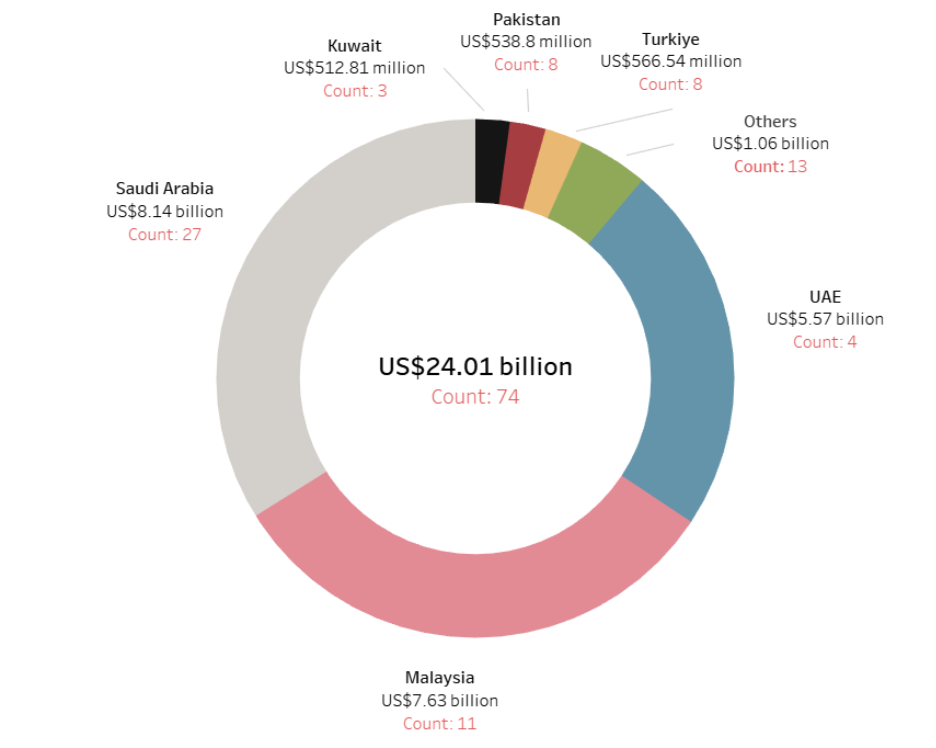
Saudi Arabia holds the largest single country share of AuM globally, contributing US$8.14 billion across 27 funds. The UAE is the third-largest market globally, accounting for US$5.57 billion in AuM from four funds. Kuwait also maintains its presence with US$512.81 million in assets across three funds.
Chart 1: Shariah real estate by region, fund count and AuM
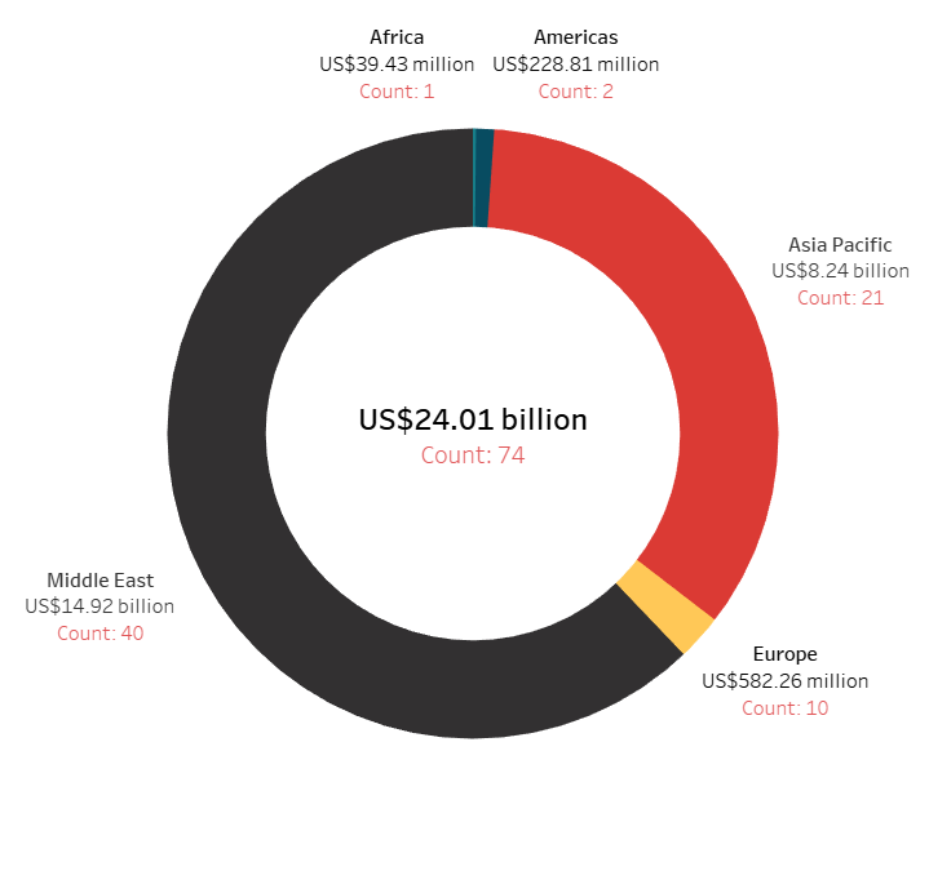
Trailing as a robust runner-up is the Asia Pacific region, with US$8.24 billion in AuM from 21 funds. Malaysia is ranked second largest in the world for Shariah real estate, after Saudi Arabia, with US$7.63 billion in AuM across 11 funds. While Pakistan accounts for the other major real estate pole of Asia Pacific, its AuM of US$538.8 million from eight funds is just a fraction of Malaysia’s.
Next up after Asia Pacific is Europe, with US$582.26 million in 10 funds. Turkiye leads the European real estate sector, with approximately 97% of AuM, across eight funds.
The remaining regions – the Americas and Africa – collectively account for less than US$268.24 million in combined AuM, though their individual growth stories hint at broader acceptance.
Chart 2: Shariah real estate by country, fund count and AuM
Quarter-on-quarter devaluation
The Shariah compliant real estate sector experienced a moderate overall contraction between the second and third quarters of 2025, driven primarily by a significant decline in the Middle East, which remains the largest market.
The total global AuM for all the regions fell from US$25.18 billion in Q2 2025 to US$24 billion in Q3 2025, representing an overall decrease of 4.68%.
Regional performance was polarized, with strong growth in the West and Asia Pacific countered by a sharp downturn in the Middle East.
Europe saw the most explosive growth in percentage terms, with total AuM rising 18.15% from US$485.33 million to US$573.4 million.
The Americas showed strong expansion too, increasing its AuM by 8.5%, from US$210.83 million to US$228.75 million.
Asia Pacific had modest growth, registering a 2.23% increase in AuM, which reached US$8.24 billion in Q3 2025.
The Middle East, despite its decline, still represents the largest share of the market, but its AuM dropped by 8.94%, falling from US$16.38 billion to US$14.9 billion.
Africa showed no change in AuM, holding steady at US$39.37 million.
Table 1: Real estate regional changes
| Region | Q2 2025 AuM (US$ million) | Q3 2025 AuM (US$ million) | Change (%) |
| Africa | 39.37 | 39.37 | 0% |
| Americas | 210.83 | 228.75 | 8.5% |
| Asia Pacific | 8,063.93 | 8,243.57 | 2.23% |
| Europe | 485.33 | 573.4 | 18.15% |
Malaysia, UAE REITs top size, Turkiye’s Albaraka leads performance
While the overall market experienced a moderate decline in AuM, an examination of the largest individual Shariah compliant real estate funds reveals a strong concentration of capital in a few key vehicles, primarily based in the Middle East and Asia Pacific.
The top 10 largest funds collectively hold over US$15.6 billion in AuM. The list is heavily dominated by two funds, each with an AuM over US$4 billion: the KLCC REIT, managed by Malaysian twin-tower operator KLCC Property Holdings, and the Dubai Residential REIT, managed by DHAM REIT Management. These two funds alone account for approximately 56% of the total AuM of the top 10 funds.
In contrast, the 10th largest fund on the list, the Alkhabeer REIT Fund (Alkhabeer Capital), has an AuM of US$540.39 million.
Table 2: Largest global Shariah real estate funds
| Rank | Fund | Manager | AuM (US$ million) |
| 1 | KLCC REIT | KLCC Property Holdings | 4,489.37 |
| 2 | Dubai Residential REIT | DHAM REIT Management | 4,389.48 |
| 3 | Axis-REIT | Axis-REIT Managers Berhad | 1,264.62 |
| 4 | Amanah Hartanah Bumiputera | Pelaburan Hartanah | 1,209.45 |
| 5 | Emirates REIT | Equitativa Group | 886.00 |
| 6 | Al Rajhi REIT Fund | Al Rajhi Capital | 853.13 |
| 7 | Jadwa REIT Saudi fund | Jadwa Investment | 744.32 |
| 8 | Jadwa REITs Fund | Jadwa Investment | 712.47 |
| 9 | Bonyan REIT | BSF Capital | 566.19 |
| 10 | Alkhabeer REIT Fund | Alkhabeer Capital | 540.39 |
On the performance front, Turkiye’s Albaraka Portfoy dominated the rankings for Shariah real estate performance in the third quarter. The Albaraka Portfolio Real Estate Participation Short Term Participation Free (TL) Fund took the number one spot with a three-month return of 10.6%. The same manager's Albaraka Portfolio Management Bereket Participation Real Estate Investment Fund followed closely with a return of 8.98%.
The list of top funds also highlights diversity in Shariah compliant real estate products. A specialized sector, the Al-'Aqar Healthcare REIT, managed by JLG REIT Manager, was the third best performer, yielding a 5.57% return.
The fourth and fifth spots were held by the Riyad REIT (Riyad Capital) and the HSBC FTSE EPRA NAREIT Developed Islamic UCITS ETF (HSBC Asset Management), with returns of 5.38% and 5.19%, respectively.
Table 3: Top performing Shariah real estate funds
| Rank | Fund | Manager | Three-month return (%) |
| 1 | Albaraka Portfolio Real Estate Participation Short Term Participation Free (TL) Fund | Albaraka Portfoy | 10.6 |
| 2 | Albaraka Portfolio Management Bereket Participation Real Estate Investment Fund | Albaraka Portfoy | 8.98 |
| 3 | Al-'Aqar Healthcare REIT | JLG REIT Managers | 5.57 |
| 4 | Riyad REIT | Riyad Capital | 5.38 |
| 5 | HSBC FTSE EPRA NAREIT Developed Islamic UCITS ETF | HSBC Asset Management | 5.19 |
Outlook
While the Middle East and Asia Pacific hold the critical mass, the next chapter of Shariah real estate appears to be written in the West and beyond.
The future of the sector is closely tied to mega-development projects in the Islamic heartland. Saudi Arabia, in particular, is positioned to inject hundreds of billions of dollars into new properties under its colossal NEOM project.
Monumental Saudi projects like Jeddah Economic City and the Thakher Makkah development promise to fuel extraordinary growth and solidify the Kingdom’s role as the preeminent investment powerhouse in Shariah real estate.
The explosive growth in European AuM – up 18.15% – and strong results in the Americas – up 8.5% – demonstrate the successful geographic diversification that institutional investors are seeking.
However, the sharp 9% contraction in the Middle Eastern AuM highlights the region's current volatility, underscoring the necessity for regulatory stability and product maturity to match its sheer scale.
Despite this localized challenge, the consistent high returns from top-performing funds, such as those in Turkiye and specialized products like healthcare REITs, prove the fundamental profitability and appeal of Shariah compliant real assets.
Ultimately, the sector's long-term health hinges on its ability to balance the immense, state-backed capital injection in its heartland with the continued institutionalization and diversification of investment avenues across the globe.
Restricted Access
Login to continue reading (existing subscriber)
Subscribe NOW and get:
- Gain unlimited access through all key operating platforms
- Full access to all listed Islamic funds & fund profiles
- Unlimited access to all Islamic fund managers
- Access to all exclusive articles, reports, podcasts & videos
- Complimentary access to all IFN Investor Forums
