




- A specialized sector with rapid expansion
- Modest scale of market highlights need for greater liquidity solutions
- Future growth rooted in stability and demand for ethical investing
Overview
In a global financial arena characterized by sharp market swings and a thirst for speculation, a focused and ethically grounded segment is quietly establishing its foothold. The Shariah money market, operating within the wider Islamic finance landscape, provides investors with an alternative founded on principled concepts.
While its asset base is dwarfed by the immense size of the conventional market, its recent strong performance and increasing sophistication point toward a stable and promising path forward.
The trajectory of the Islamic money market involves both clear potential and ongoing hurdles. By the close of Q3 2025, total AuM in this space reached US$42.52 billion, spread across 258 funds, according to the IFN Investor Funds Database.
This figure represents a healthy expansion, climbing 2.73% from the US$37.7 billion recorded at the end of the previous quarter. Despite this robust growth, it’s worth noting that the total market size remains minimal when compared to the trillions of dollars held by conventional money market funds in the US alone.
Challenges
The relatively moderate size of this financial sector reveals a persistent challenge: many financial institutions in Muslim-majority nations still face difficulties efficiently managing their short-term cash reserves. A central obstacle is the scarcity of high-quality, dollar-denominated financial instruments necessary for effective cross-border liquidity management.
Furthermore, the market suffers from diverse domestic regulatory landscapes. While nations like Malaysia have successfully fostered a sophisticated and diverse Islamic money market, development in many other regions lags. Major financial centers in the GCC such as Saudi Arabia and Bahrain, predominantly rely on commodity Murabahah for their cash needs.
Elsewhere, markets in Africa and the Americas remain nascent, frequently impeded by weak financial infrastructure and insufficient regulatory support. This variation in Shariah interpretation means tools like commodity Murabahah are common in several countries (Malaysia, Saudi Arabia, Qatar, etc.) but lack universal acceptance.
Investment opportunity
For investors prioritizing both financial stability and ethical compliance, the Islamic money market offers a compelling investment case. Fund managers tracked by the IFN Investor Funds Database have achieved consistent annual returns, holding pace with their conventional peers despite the complex demands of adhering to both financial and religious requirements.
The market's story is fundamentally one of geography, with the Middle East establishing itself as the undisputed capital. Leading global Islamic finance hubs – including Riyadh, Dubai, Kuala Lumpur, Manama and London – have become centers of excellence, thanks to progressive regulatory frameworks and a deep pool of industry expertise.
Regional and domicile breakdown
An analysis of regional activity reveals that the Middle East and Asia Pacific are the core pillars of the market, though their underlying structures are vastly different.
Middle Eastern concentration: The Middle East holds the largest pool of capital at US$25.34 billion. This capital is managed by a comparatively small number of funds, leading to an average fund size more than six times that of the Asia Pacific. This signifies a market where large, institutional funds dominate. The region also spearheaded absolute AuM growth for the quarter, expanding by 6.58%.
Asia Pacific proliferation: The Asia Pacific is defined by its sheer volume of funds, accounting for 189 funds with US$13.86 billion in AuM. This suggests a far more fragmented and dynamic market, likely driven by robust regional demand and favorable regulatory conditions. Despite the high number of funds, the region experienced a minor AuM decline of 1.92% for the quarter.
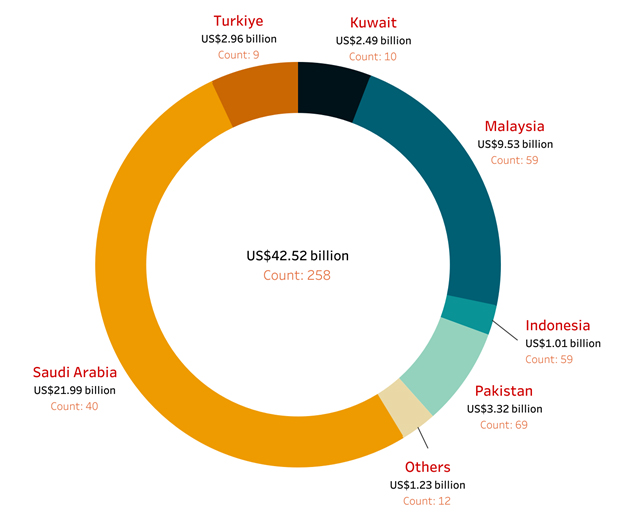
Domicile leaders: At the country level, Saudi Arabia leads with US$21.99 billion in AuM across 40 funds. Malaysia is the second largest by assets at US$9.53 billion. Pakistan has the highest number of funds globally, hosting 69.
Table 1: Quarterly percentage change in money market AuM by region
| Region | Q2 2025 (US$ million) | Q3 2025 (US$ million) | Change (%) |
| Africa | 20.12 | 22.39 | 11.3 |
| Americas | 34.07 | 348.22 | 2.2 |
| Asia Pacific | 14,128 | 13,856.08 | -1.92 |
| Europe | 3,131.76 | 2,960.68 | -5.46 |
| Middle East | 23,771.6 | 25,335.87 | 6.58 |
| Total | 41,392.19 | 42,523.24 | 2.73 |
Chart 1: Shariah money market by regional AuM and fund count
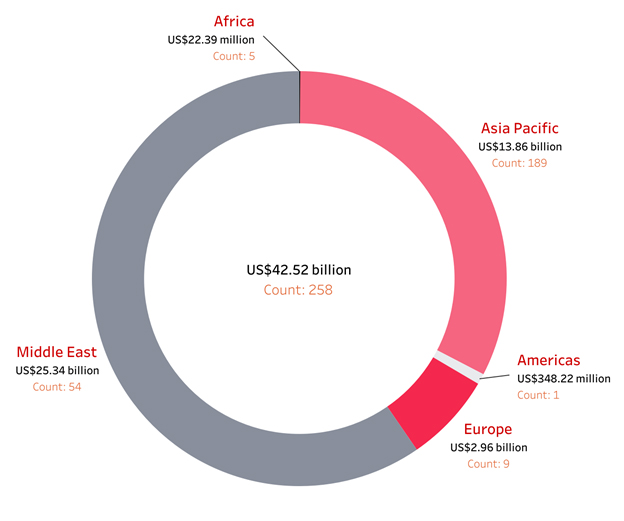
Chart 2: Shariah money market by domicile and fund count
Fund performance
The performance metrics for Q3 2025 highlight a competitive environment with a clear standout winner.
The KFH Capital Money Market Fund led the top performing funds, delivering an exceptional return of 17.74%.
Artal Capital manages two of the top five funds, which achieved identical returns of 5.89%.
Overall, the returns of the top five funds demonstrated a substantial performance gap between the market leader and the remaining high achievers.
Table 2: Top Islamic money market funds by three-month returns
| Rank | Fund | Manager | 3-month returns (%) |
| 1 | KFH Capital Money Market Fund (KWD) | KFH Capital | 17.74 |
| 2 | Artal MENA Fund (Class B) | Artal Capital | 5.89 |
| 3 | Artal Muharaba Fund (Class A) | Artal Capital | 5.89 |
| 4 | Yaqeen SAR Murabaha Fund | Yaqeen Capital | 5.71 |
| 5 | ANB Capital SAR Trade Fund | ANB Capital | 5.36 |
The capacity of the market is best illustrated by the sheer size of its largest funds: the top 10 funds alone collectively hold US$24.21 billion in assets, accounting for more than half of the total global AuM.
Table 3: Islamic money market funds by AuM
| Rank | Fund | Manager | AuM (US$ million) |
| 1 | SNB Capital Al Sunbullah SAR | SNB Capital | 5,345.46 |
| 2 | Al Rajhi Awaeed Fund | Al Rajhi Capital | 5,071.79 |
| 3 | SNB Capital Saudi Riyal Trade Fund | SNB Capital | 3,299.29 |
| 4 | AHAM Aiiman Money Market Fund | AHAM Capital Asset Management | 3,244.47 |
| 5 | Principal Islamic Deposit Fund - Class AI | Principal Asset Management | 1,733.16 |
| 6 | Alpha Murabaha Fund | Alpha Capital | 1,493.39 |
| 7 | Watani KD Money Market Fund II | NBK Wealth | 1,208.77 |
| 8 | Riyad SAR Liquidity Fund | Riyad Capital | 1,094.57 |
| 9 | Boubyan KD Money Market Fund II | Boubyan Capital | 870.68 |
| 10 | ANB Capital SAR Trade Fund | ANB Capital | 849.04 |
Outlook
The prospects for the Islamic money market appear favorable, propelled by its inherent stability and the increasing global appetite for ethical investments.
Although its combined AuM of US$42.52 billion makes it shallow compared to the multi-trillion-dollar conventional sector, this smaller footprint is a direct reflection of its principled, asset-backed foundation.
Looking ahead, S&P Global forecasts that the overall global Islamic finance market will expand to US$7.7 trillion by 2033. This trajectory positions the money market for continued, purposeful expansion, increasingly appealing to a global audience seeking financial solutions that harmonize profit with ethical standards.
Restricted Access
Login to continue reading (existing subscriber)
Subscribe NOW and get:
- Gain unlimited access through all key operating platforms
- Full access to all listed Islamic funds & fund profiles
- Unlimited access to all Islamic fund managers
- Access to all exclusive articles, reports, podcasts & videos
- Complimentary access to all IFN Investor Forums
