




- Fixed income returns led by Sukuk
- Sukuk issuance seen at US$200 billion in 2025, from US$193 billion in 2024
- Volatility rears its head though as overall AuMs tumble
Overview
Islamic fixed income funds — with the versatile Sukuk as the core component — are carving out a dynamic space for this asset category, attracting a growing crowd that wishes to have investment returns aligned with their faith.
From the bustling markets of Malaysia and Indonesia to the financial hubs of Luxembourg and the Gulf, this fixed income sector is proving to be a force to be reckoned with. Innovations in structuring have led to a variety of instruments that cater to diverse investor needs, including Murabahah deposits, Islamic commercial papers and Islamic treasury bills.
Sovereign entities in countries like Saudi Arabia, other GCC nations, Malaysia, and Indonesia utilize these instruments for government financing and market development. Supranational bodies, such as the IsDB are also significant issuers.
In 2024, S&P Global Ratings reported a 15% growth in Sukuk issuance, reaching US$193 billion, and projects it could hit as high as US$200 billion in 2025. A significant portion of this growth is expected to come from foreign currency-denominated Sukuk, highlighting the market's international appeal and diversification.
Investment opportunity
The Islamic fixed income universe is a diverse one, offering a variety of products that prohibit Riba and Gharar. But it can also be a volatile industry.
The IFN Investor Funds Database tracked 135 Islamic fixed income funds with a total AuM of US$10.73 billion in Q2 2025. Saudi Arabia led the pack with US$4.43 billion shared by 19 funds, followed by Turkiye (US$2.18 billion, 19 funds), Malaysia (US$1.27 billion, 18 funds), Pakistan (US$1.22 billion, 37 funds) and others (US$1.29 billion, 23 funds).
The start of the year was a tale of rapid expansion. Europe, in particular, saw a stellar jump in total AuM value, spiking by 15.89% to US$6.46 billion. The Americas and the Middle East also enjoyed positive growth, rising by 7.63% and 3.56%, respectively.
Chart 1: Islamic fixed income funds of key nations at end-Q2 2025
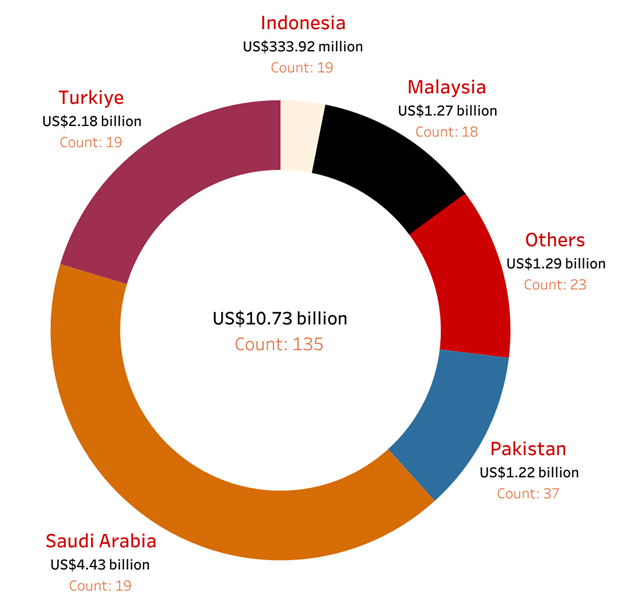
Chart 2: Islamic fixed income funds by region at end-Q2 2025
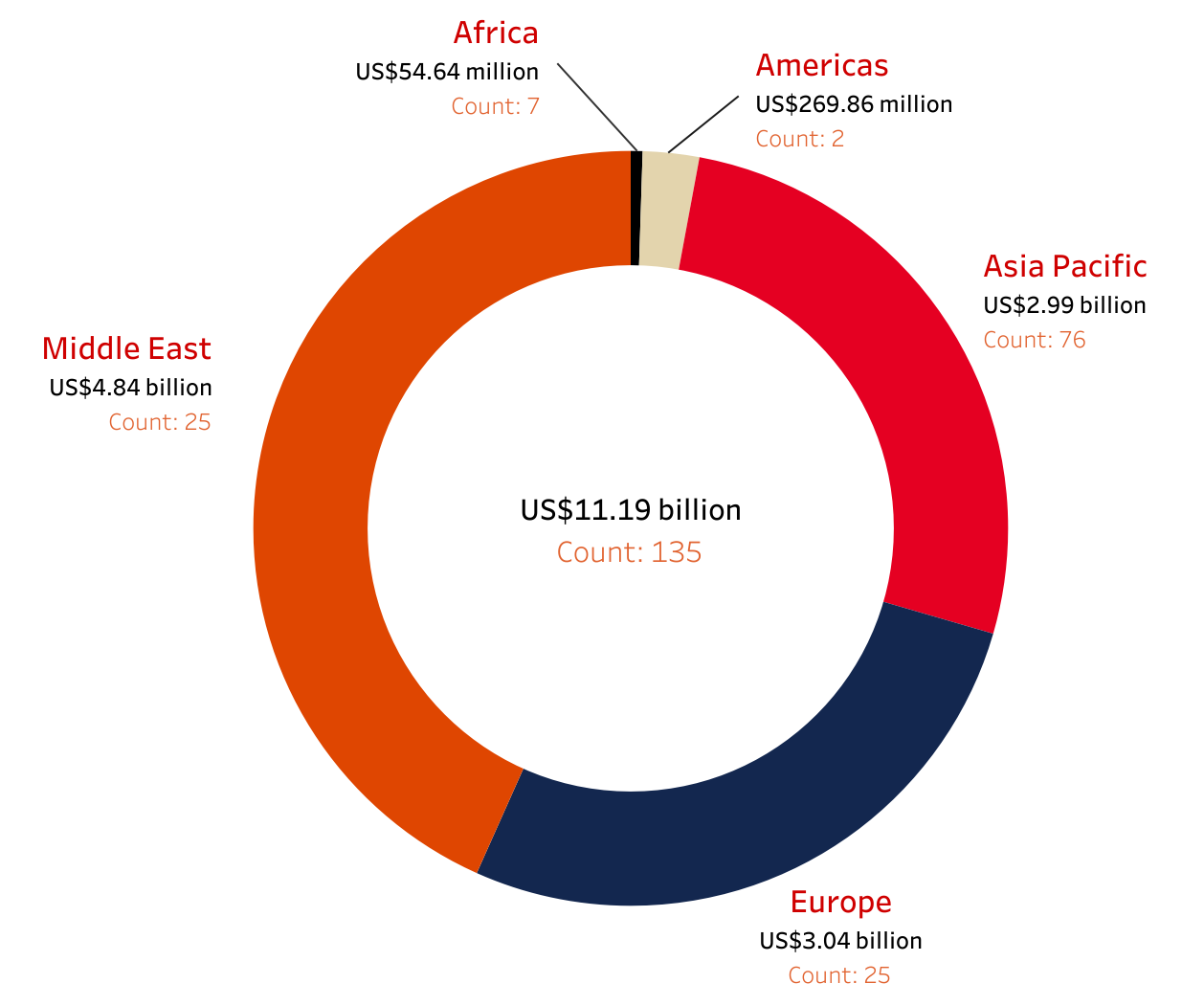
However, the second quarter of 2025 brought a shift in the narrative. While Europe, the Americas and Asia Pacific continued their upward climb with growth in AuM, Africa and the Middle East regions hit a speed bump. The Middle East experienced the sharpest decline, with AuM dropping by 1.62% to US$4.84 billion. Africa followed with a 1.53% contraction to US$54.64 million. In contrast, Europe, Americas and the Asia Pacific posted gains of 32.75%, 8.0% and 2.44%, respectively.
Table 1: Islamic fixed income funds regional performance in Q1-Q2 2025
| Region | AuM Q1 2025 (US$ million) | AuM Q2 2025 (US$ million) | Change (%) |
| Americas | 249.88 | 269.86 | 8 |
| Africa | 55.49 | 54.64 | -1.53 |
| Europe | 2,290.51 | 3,040.57 | 32.75 |
| Asia Pacific | 2,918.63 | 2,989.88 | 2.44 |
| Middle East | 4,918.64 | 4,839.08 | -1.62 |
Despite this mixed performance, the largest fund, the Riyad SAR Diversified Trade Fund, held its own, with US$1.41 billion in AuM, followed closely by the Ziraat Portfolio Amber Money Market Participation Free (TL) Fund at US$1.4 billion.
Table 2: Top Islamic fixed income funds by AuM
| Rank | Fund | Manager | AuM (US$ million) |
| 1 | Riyad SAR Diversified Trade Fund | Riyad Capital | 1,410.33 |
| 2 | Ziraat Portfolio Amber Money Market Participation Free (TL) Fund | Ziraat Portfoy | 1,402.55 |
| 3 | SNB Capital Diversified Saudi Riyal Fund | SNB Capital | 650.31 |
| 4 | Albilad SAR Murabaha Fund | Albilad Capital | 650.02 |
| 5 | Aiiman Income Extra Fund | AIIMAN Asset Management | 609.95 |
| 6 | AlJazira Saudi Riyal Murabaha Fund | Aljazira Capital | 470.77 |
| 7 | Riyad SAR Trade Fund | Riyad Capital | 379.45 |
| 8 | Principal e-Cash Fund (Class A) | Principal Asset Management | 355.16 |
| 9 | Alistithmar Capital SAR Murabaha Fund | Alistithmar Capital | 315.06 |
| 10 | Ziraat Portfolio Short-Term Rental Certificate Participation (TL) Fund | Ziraat Portfoy | 292.25 |
On the returns front, the HBL Islamic Fixed Term Fund from Pakistan was the standout star in Q1 2025, delivering a remarkable 17.53% three-month return. Fast forward to Q2 2025, the spotlight shifted to Saudi Arabia's AlJazira Saudi Riyal Murabaha Fund, which led the charts with a 4.69% three-month return. This dynamic shows a competitive landscape where funds are constantly vying for the top spot, and returns being volatile as well.
Table 3: Top Islamic fixed income funds, by three-month returns
| Rank | Fund | Manager | Three-month return (%) |
| 1 | AlJazira Saudi Riyal Murabaha Fund | Aljazira Capital | 4.69 |
| 2 | Lotus Halal Fixed Income Fund | Lotus Capital | 3.54 |
| 3 | Al Jazira USD Murabaha Fund | Aljazira Capital | 3.48 |
| 4 | Trimegah Dana Tetap Syariah 2 | Trimegah Asset Management | 2.68 |
| 5 | I-Hajj Syariah | Insight Investments Management | 2.37 |
Regulatory framework
The market’s future isn’t without its challenges. A change in Shariah standards in the GCC countries could pose a risk to the Islamic fixed income market. The evolving Shariah requirements may introduce structural complexities in some GCC-issued Sukuk, potentially carrying additional risks for investors compared to conventional instruments. The market's growth relies on the assumption of no major shifts to current Shariah standards.
Outlook
Despite potential headwinds, the Islamic fixed income market looks poised for continued growth, promising a growing array of opportunities for investors who seek a blend of ethical principles and financial stability.
Geopolitical tensions in the Arab world also cast a shadow, as they could threaten the stability of Sukuk issuance. Perhaps the biggest question mark hangs over the US Federal Reserve. If the Fed holds US interest rates not too far from where they are — with moderate cuts going forth — global borrowing costs could remain relatively high, resulting in higher-yielding bonds and potentially reduced volumes of new Sukuk coming to the market.
Restricted Access
Login to continue reading (existing subscriber)
Subscribe NOW and get:
- Gain unlimited access through all key operating platforms
- Full access to all listed Islamic funds & fund profiles
- Unlimited access to all Islamic fund managers
- Access to all exclusive articles, reports, podcasts & videos
- Complimentary access to all IFN Investor Forums
