




- Multiple IMF bailouts do not impact Pakistan’s standing as Islamic finance hub
- Pakistan’s Shariah AuM at 11% of Asia Pacific’s total, second behind Malaysia
- More initiatives, including investor fee reductions, underway to bolster market
Overview
Pakistan, a nation grappling with persistent economic instability, is aiming to be an unexpected leader in Asia Pacific's Islamic asset management sector – following the October 2024 constitutional amendment for its financial system to be Riba-free by the 1st January 2028.
Avoiding a sovereign debt default, Pakistan's finance minister projected a gradual and sustainable growth rate of 2.7% for 2025 despite seeking a 24th bailout from the IMF. Against this backdrop, the South Asian country became the second-largest market for Islamic asset management in Asia – trailing only Malaysia.
The IFN Investor Database showed that at the end of Q2 2025, Pakistan's Shariah AuM stood at US$6.02 billion, representing 11.06% of Asia Pacific’s total Islamic assets. The country's capital market is well-developed, with nearly half of the mutual funds offered being Shariah compliant.
Investment opportunity
The Islamic asset management sector in Pakistan shows a strong preference for money market instruments. A substantial portion – one-third – of these money market funds are managed by asset management companies for retirement and pension purposes, reflecting a common practice within Pakistani companies and the government.
The Pakistan Stock Exchange – which consolidated the Karachi, Islamabad and Lahore stock exchanges in January 2016 – offers a diverse array of investment vehicles including common equities, derivative trading, exchange-traded funds and margin trading.
Since the amalgamation, market capitalization increased to US$49.986 billion by end-February 2025 from US$37.11 billion reported in June 2024.
The Roshan Equity Investment Account continues to be a key initiative for overseas Pakistanis to invest on the stock exchange, allowing non-resident Pakistanis to open a bank account digitally and put money in a variety of instruments, including Shariah compliant stocks, bonds and ETFs.
Several Pakistani banks, such as UBL, MCB, Bank AL Habib and Meezan Bank, offer this service via the Roshan Digital Account, which involves selecting a brokerage firm and transferring funds to a central depository company account.
Special Convertible Rupee Account (SCRA) remains the mechanism for foreign nationals and institutions to invest in the Pakistani capital market. The State Bank of Pakistan continues to publish weekly data on the SCRA, showing buying and selling activities by foreign investors.
Asset spread
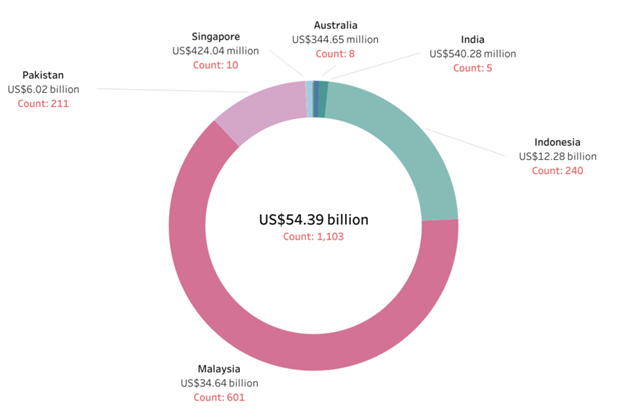
Pakistan's Islamic AuM is the second largest in Asia Pacific, with the aforementioned US$6.02 billion from a total asset base of US$54.39 billion for the region.
Though significantly smaller than Malaysia's US$34.64 billion, Pakistan's AuM is more than double that of Indonesia's US$2.88 billion. It far surpasses India's US$540.28 million, Singapore's US$424.04 million and Australia's US$344.65 million.
Pakistan’s Islamic fund count of 211 is the third largest in the region, after Malaysia (601) and Indonesia (240) but ahead of Singapore (10), Australia (8) and India (5).
Chart 1: Islamic assets total AuM across the Asia Pacific region
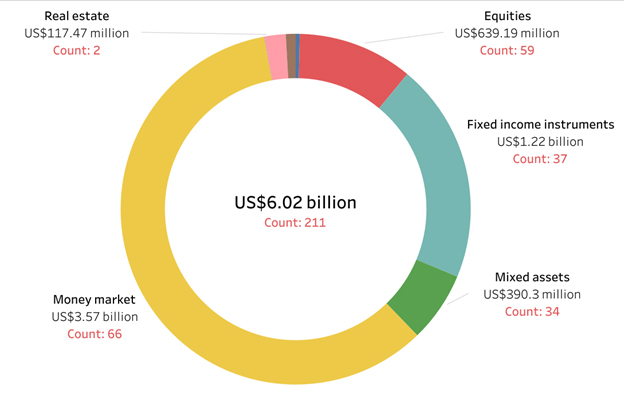
Within Pakistan's Islamic asset management sector, there is a clear concentration of assets in specific classes.
The largest component is the money market, which accounts for US$3.57 billion in AuM and 66 funds. This dominance is reflected in the fact that money market funds make up eight of the top ten largest funds in the nation.
The next largest component is fixed income instruments, with AuM of US$1.22 billion and 37 funds. This is followed by equities, which have US$639.19 million in AuM and the highest number of funds at 59.
Mixed assets make up US$390.3 million with 34 funds. The smallest allocation is in real estate, with US$117.47 million and only two funds. This data highlights a strong preference for liquid and stable investments within Pakistan's Islamic finance market.
Chart 2: Pakistan’s Islamic AuM by asset class
Fund size, performance
The largest Islamic fund manager in Pakistan is Al Meezan Investment Management, whose Meezan Cash Fund sat atop an AuM of US$790.7 million at the end of Q2 2025. The fund says on its prospectus that its objective is to ensure optimum capital preservation and a reasonable rate of return via investing primarily in liquid Shariah compliant money market securities.
Other large-sized Islamic funds in Pakistan are Faysal Asset Management’s Faysal Islamic Cash Fund (US$331.32 million), HBL Asset Management’s HBL Asset Management (US$286.99 million), Al Meezan Investment Management’s Meezan Rozana Amdani Fund (US$233.34 million) and Alfalah Asset Management’s Alfalah Islamic Money Market Fund (US$220.53 million).
Table 1: Largest Pakistani Islamic funds by AuM
| Rank | Fund | Manager | AuM (US$ million) |
| 1 | Meezan Cash Fund | Al Meezan Investment Management | 790.7 |
| 2 | Faysal Islamic Cash Fund | Faysal Asset Management Limited | 331.32 |
| 3 | HBL Islamic Money Market Fund | HBL Asset Management LTD | 286.99 |
| 4 | Meezan Rozana Amdani Fund | Al Meezan Investment Management | 233.34 |
| 5 | Alfalah Islamic Money Market Fund | Alfalah Asset Management Limited | 220.53 |
The top-performing Shariah fund in Pakistan as of the end of Q2 2025 was UBL Funds’ Al-Ameen Islamic Energy Fund, which posted a three-month return of 71.31%. On its prospectus, Al-Ameen said its objective was to provide investors with long term capital growth from an actively managed portfolio of Shariah compliant companies spread across the energy sector, from petroleum to gas, coal, and nuclear power, as well as renewables such as hydroelectric, wind and solar power.
Other major fund performers and their three-month returns were Arif Habib Dolmen REIT’s Dolmen City REIT (72.95%), Al Habib Asset Management’s Al Habib Islamic Stock Fund (72.85%), UBL Funds’ Al-Ameen Islamic Retirement Savings Fund Equity (70.9%) and Al-Ameen Shariah Stock Fund (66.67%).
Table 2: Pakistani Islamic funds by performance
| Rank | Fund | Manager | Three-month returns (%) |
| 1 | Al-Ameen Islamic Energy Fund | UBL Funds | 73.31 |
| 2 | Dolmen City REIT | Arif Habib Dolmen REIT | 72.95 |
| 3 | Al Habib Islamic Stock Fund | Al Habib Asset Management | 72.85 |
| 4 | Al-Ameen Islamic Retirement Savings Fund - Equity | UBL Funds | 70.9 |
| 5 | Al-Ameen Shariah Stock Fund | UBL Funds | 66.67 |
Regulatory framework
Pakistan operates a dual financial system, where Islamic and conventional outfits function in parallel, similar to Malaysia. The growth of Pakistan's Islamic capital market is supported by a robust regulatory framework. With the impending national conversion to a Riba-free financial ecosystem by 2028, it remains unclear how much room regulatory changes will leave for the conventional assets landscape.
The Securities and Exchange Commission of Pakistan (SECP) serves as the key regulatory authority for the corporate sector and capital markets, overseeing insurance companies, non-banking financial companies, private pension schemes and external service providers to the financial sector. The commission also possesses investigative and enforcement powers.
Key regulatory milestones include the Shariah Governance Regulations 2018, which established a comprehensive framework for Shariah-related matters in capital markets. SECP Regulators adhere to AAOIFI standards to ensure high standards and efficiency in the Islamic capital market.
For public investments, including voluntary pension schemes and pension funds, the SECP and the Mutual Funds Association of Pakistan enforce stringent rules.
Asset management companies require a license from the SECP to manage mutual funds. Under the Shariah Governance Regulations 2023, the SECP outlines minimum screening criteria for Shariah compliant companies and securities, requiring entities to obtain a declaration from the SECP before claiming Shariah compliance. At present, there are 139 Shariah advisors registered with the SECP.
Outlook
The outlook for Pakistan's Shariah finance market indicates continued efforts towards expansion and greater investor accessibility. The stock exchange implemented an initiative in July 2024 aimed at enhancing market liquidity. Along with this, Meezan Bank, a significant player in the stock exchange and an existing market maker for Shariah compliant debt securities, became the first market maker for Pakistan government-issued Ijarah Sukuk.
Further initiatives are underway to bolster the market. The SECP is working to reduce the overall fee structure for investments in mutual funds and pension schemes with the goal of attracting more retail investors.
Additionally, the SECP proposed changes to make distributor compensation more attractive, which is expected to further boost investor access to these funds. These ongoing efforts highlight Pakistan's commitment to strengthening its Islamic finance sector and its position within the global Islamic finance landscape.
Restricted Access
Login to continue reading (existing subscriber)
Subscribe NOW and get:
- Gain unlimited access through all key operating platforms
- Full access to all listed Islamic funds & fund profiles
- Unlimited access to all Islamic fund managers
- Access to all exclusive articles, reports, podcasts & videos
- Complimentary access to all IFN Investor Forums
